Bosnia and Herzegovina: The past is ever-present
Almost a year ago, I bought an Interrail ticket during a price discount campaign. I was euphoric; I wanted to travel. Then it lay unused for a while. Now it is about to expire, means: I have to travel. A holiday to fulfil a plan. What plan, I wonder, and at the same time try to come up with one. The destination should be reachable by train – and please far away, begs the wanderlust in my heart. I consider various places, but none of them feels right. I think about how long it's been since I've travelled alone, can I still do it? The days pass; two weeks before my holidays begin, I toss and turn through the night. I can't sleep, waking up. I'm standing in a cotton wool forest, fog swirling around me, my thoughts wandering, finding a junction, and suddenly, the idea. How about going to Bosnia[1]? First tentative steps and a read or two on the pages of my fellow travel bloggers, then full force: I'm going to Bosnia! A warm feeling called relief. It's half past three. Decision made.
Nine hours from Berlin to Vienna in the morning, then on to Split in southern Croatia by night train, arriving at ten o'clock. Swimming in the crystal-clear Adriatic Sea, overnight stay in a shared room at a hostel. The next day, a six-hour bus ride to Mostar.
Mostar // Herzegovina is world famous. Especially the Stari Most, the Old Bridge, is considered the city's landmark and attracts hundreds of thousands of visitors every year. The sightseers gather in groups around different coloured pennants, first on the banks of the Neretva River, then standing on the World Heritage Site, listening to the tour guide's exciting stories in English or German. There are also Chinese tourists, of course, and quite a few from Turkey. In the 16th century, the arch bridge was built from a special type of limestone to replace a simple wooden bridge and a rickety chain bridge. Its architect, Mimar Hajrudin, created a masterpiece of Ottoman engineering[2] that has always been regarded as a symbolic link between the Orient and the Occident, as an expression of the peaceful coexistence of many ethnic groups, until the bridge was destroyed by tank fire in the Bosnian War in 1993. Shortly after the end of the devastating fighting, the bridge was rebuilt true to the original in nine years with the combined efforts of the international community. Today, the Stari Most sparkles in the sunshine, but it has not been able to regain its former symbolic power. Deep are the trenches; Mostar is a divided city.
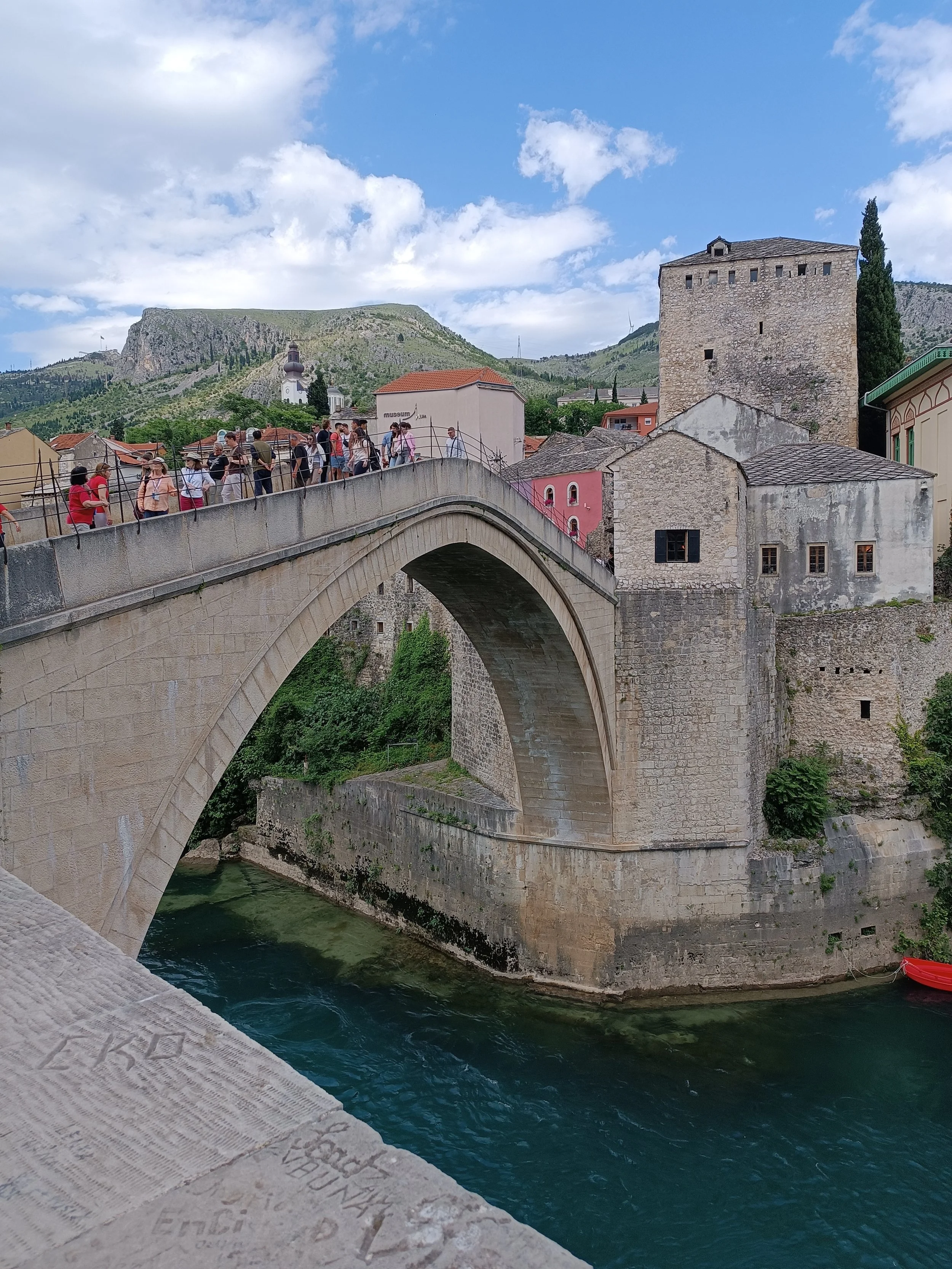
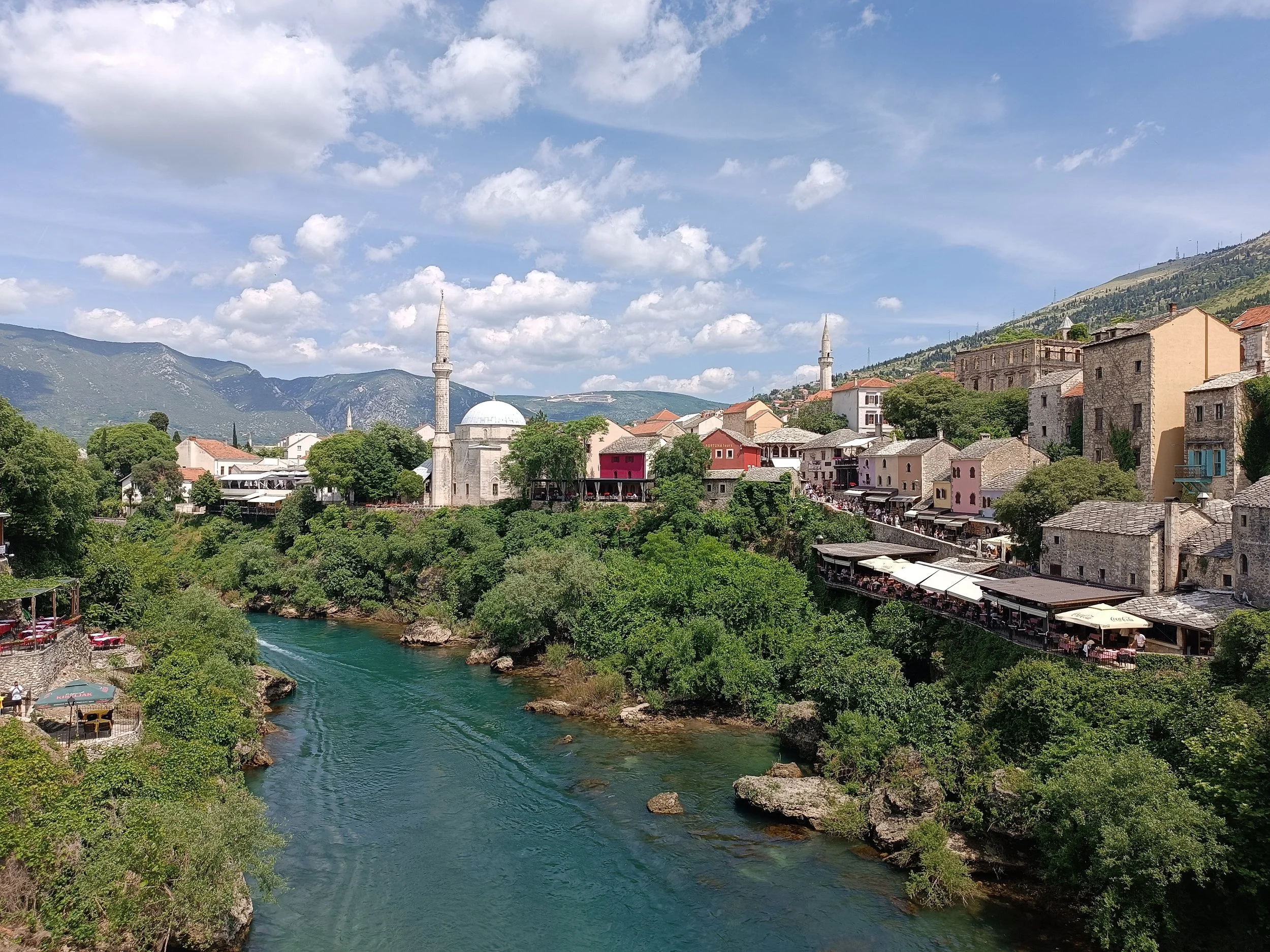
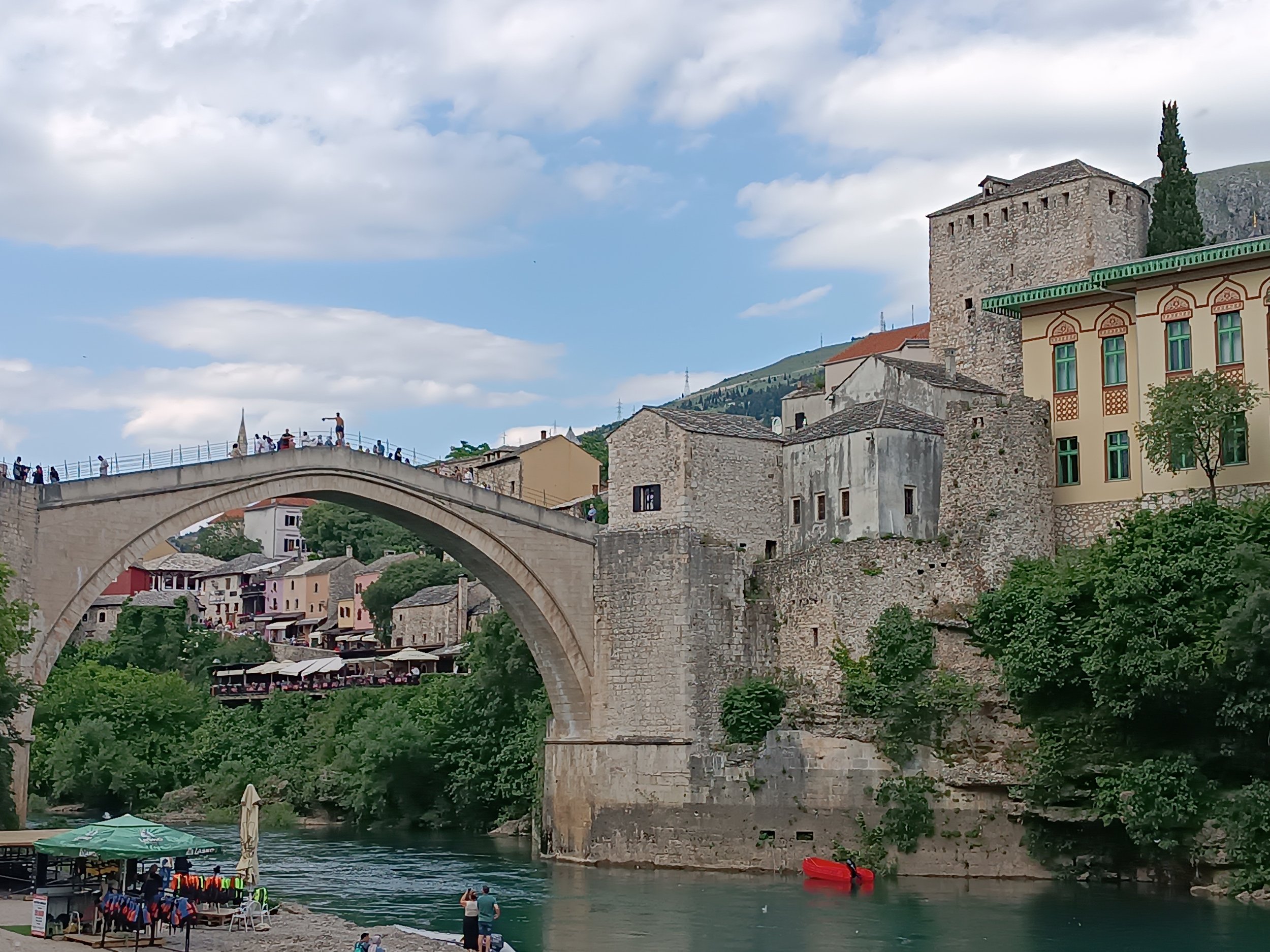
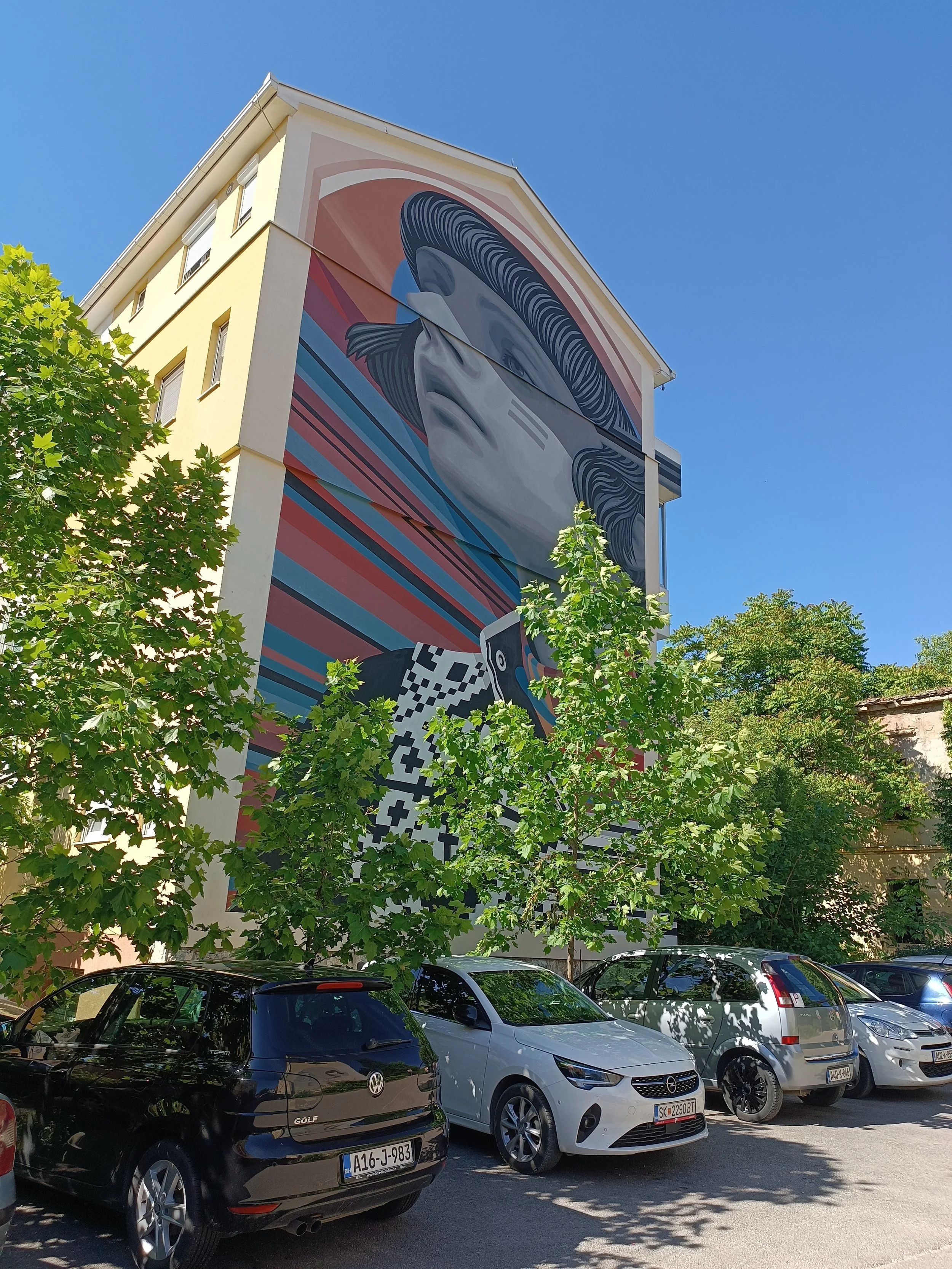
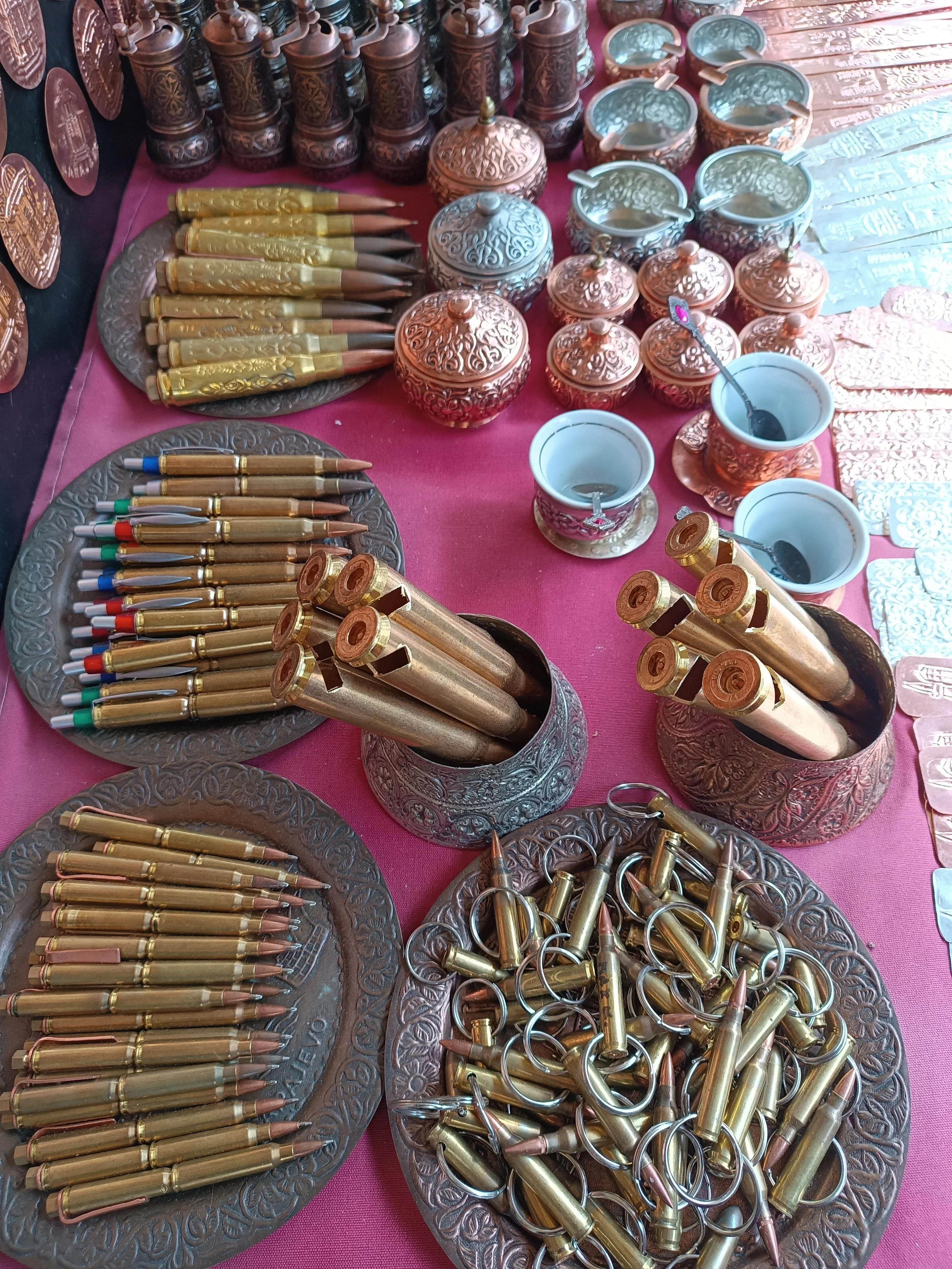
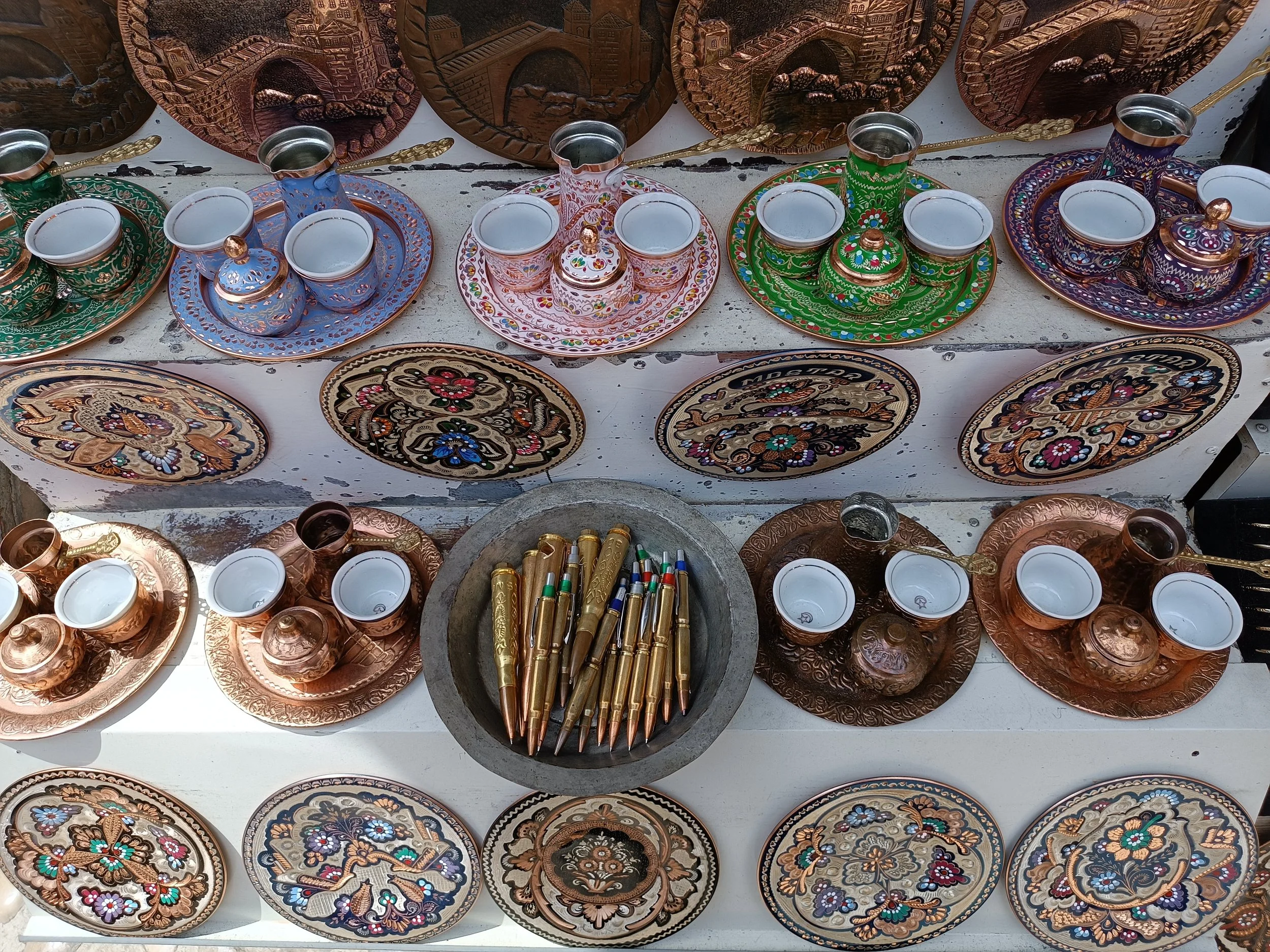
I also visit the famous bridge, take pictures of it, take pictures on it, cross it. Then I frantically flee from the many snapshot lenses, I leave you in peace and seek my own, losing myself in the maze of alleys lined with souvenir shops. Here, bullet casings are sold as pens and key rings, with beautiful craftsmanship in between. I continue walking, a fine network of paths leading me out of the old town and into a residential area. Plate-type buildings, supposedly tristesse. But this prejudice does not work here. The sky is blue and the coating is yellow, and a fabulous mural adorns one of the house walls, oversized, house front size. There is a second one at the back, and many more. Mural world. I stop, turn around, and gaze at these images for a long time. Passers-by cross my path, notice me, follow my gaze upwards, pause, and look at the murals. They look at their city. Nodding, move on. This touches me deeply. How universal it is that we forget to look around in everyday life. Then I continue my way and see a vacant house next door, its unrenovated façade is decorated with bullet holes.
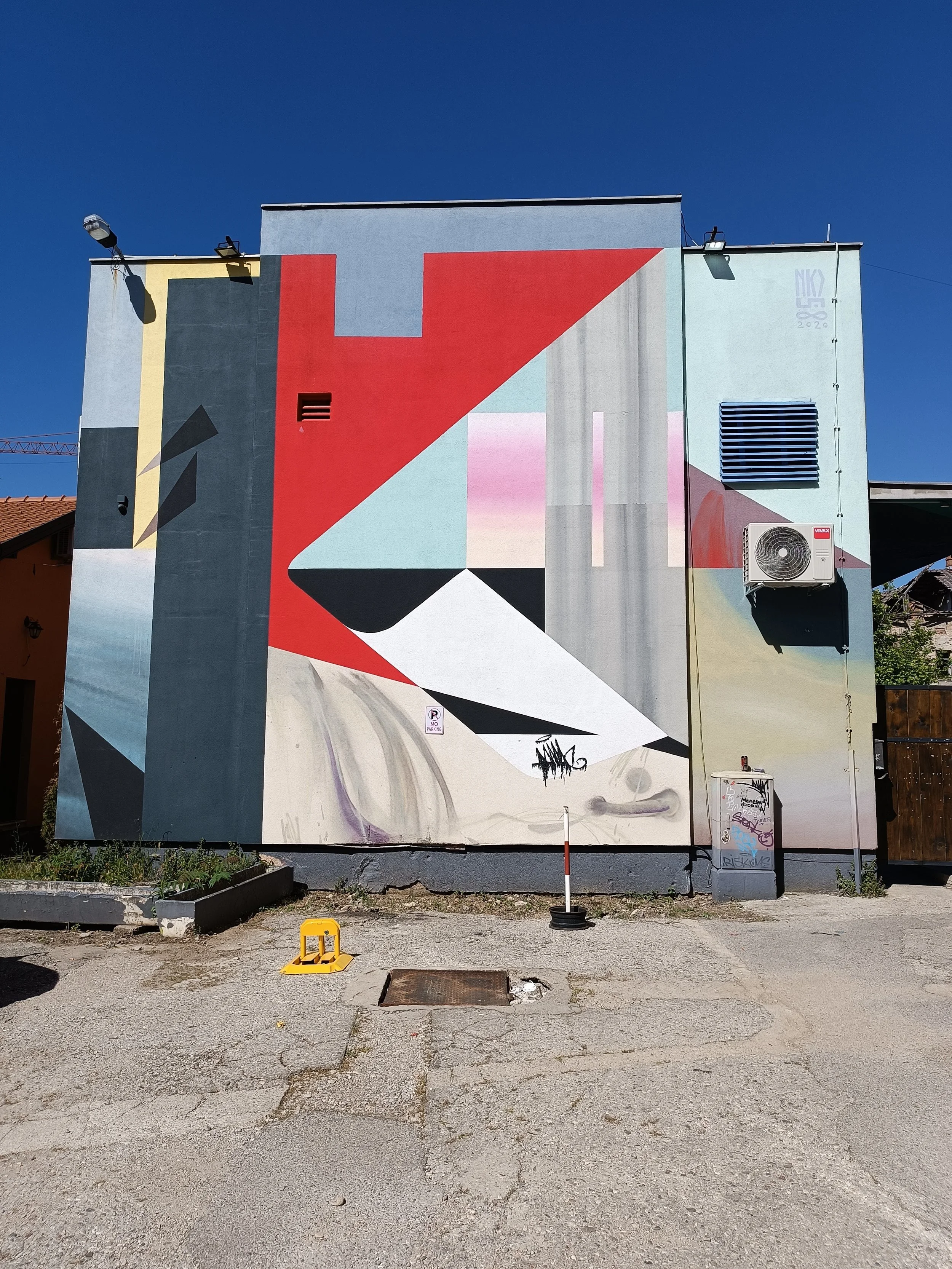
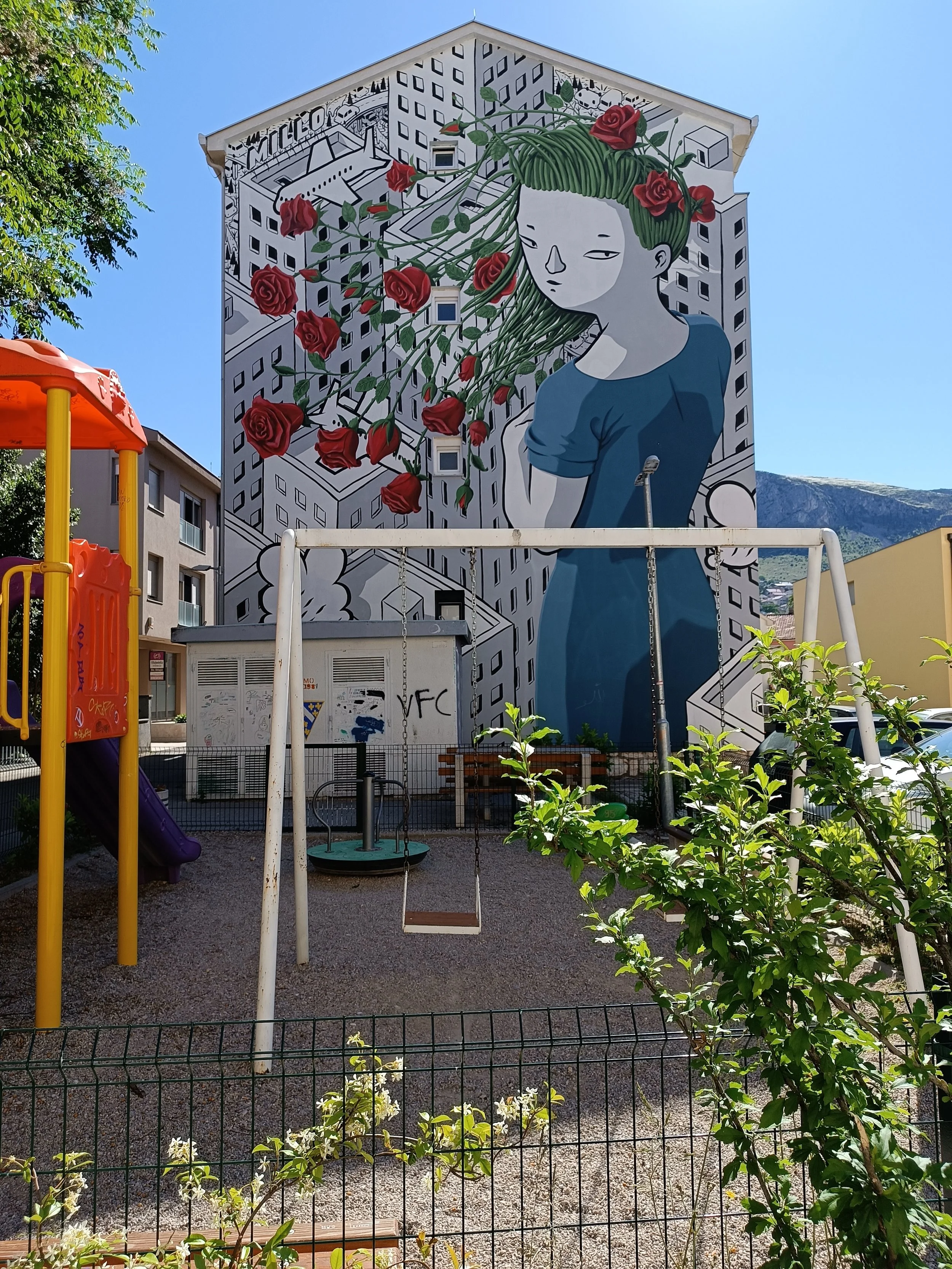
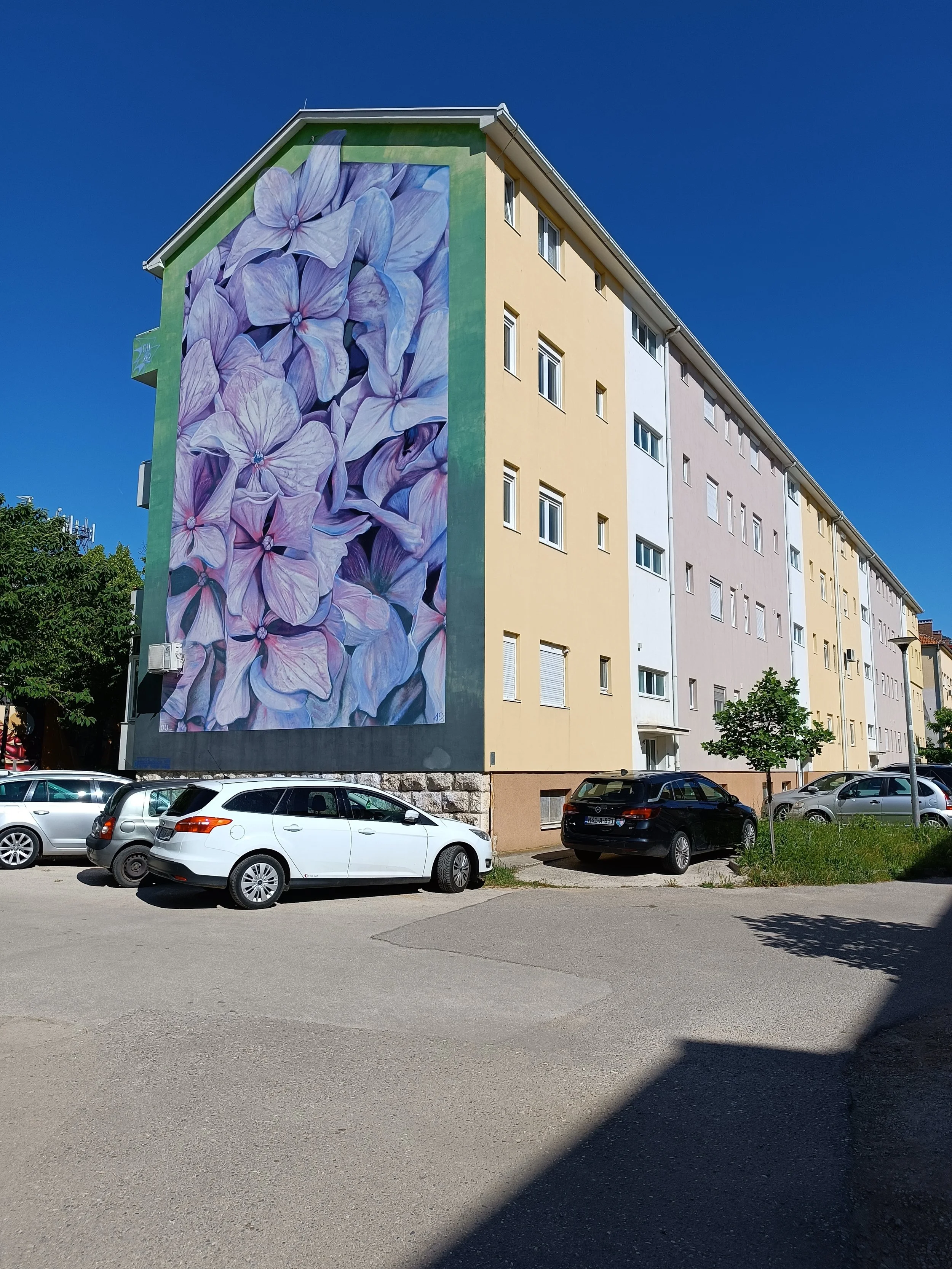
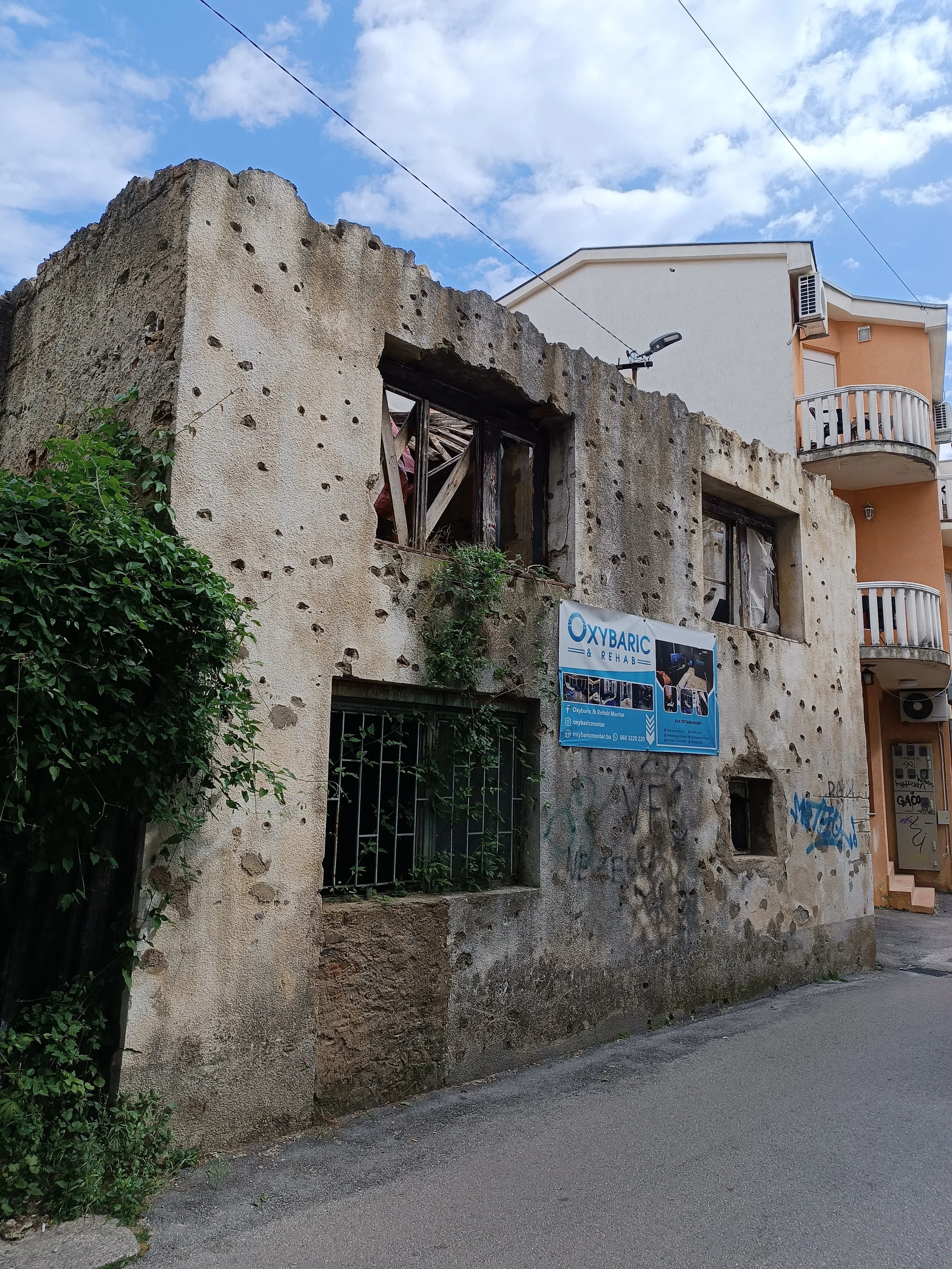
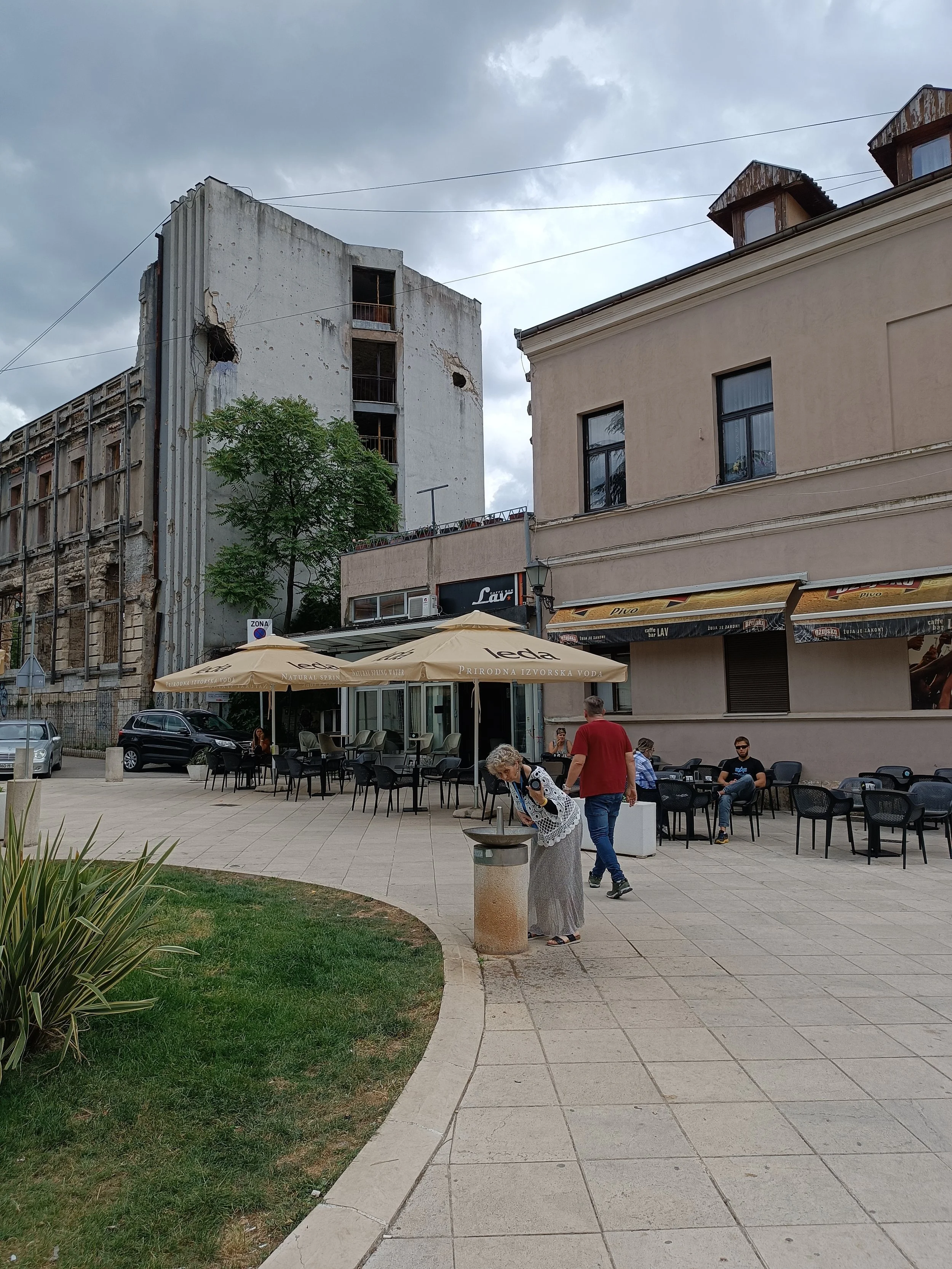
I still don't understand the history. With the break-up of Yugoslavia, war broke out in the 1990s. Bosniaks, Serbs, Croats.[3] Who fought, when and why? Where was the fighting and what was it for? Against what? The past is physically palpable, screaming from every corner but remaining strangely silent. I pore over my travel guide, I consult the internet, but the pieces of the puzzle don't seem to fit together. Who is telling the history? A country,
a divided one. I must keep walking.
It is 5:30 p.m., I am sitting on the train to Sarajevo. It has been a long and tough day, I am exhausted. Something is bothering me. My travel plans are kind of stalled. I have been travelling for five days now, and I don't feel like I have experienced much so far. I feel pressure, no, I'm putting pressure on myself. I want to see everything: the cities, the villages, the national parks, the memorials. There's not much time left. Oh, and I need to relax too. It is a holiday, after all. Where should I start? Everything is slipping away from me. In addition, the longing – his and mine.
The railway line is beautiful. I try to take pictures, but it judders and trees and bushes flicker through the window’s reflection. Never mind, then it's just for me.
When the war began in Bosnia in 1992, I was nine years old. “My country” had also recently collapsed. Fortunately, there was no war where we lived. We had the so-called Baseballschlägerjahre, key words swirl around in my head.
The Neretva creeps along in turquoise blue. Behind it are rocks, grey and stony, and others covered in leafy green vegetation. Sometimes a colony of houses, white dots with red roofs. Once, a single one. The house seems to be newly built. Who lives there?
Mountains and valleys alternate naturally, now a wide valley. Scattered hills. Juddering, juddering.
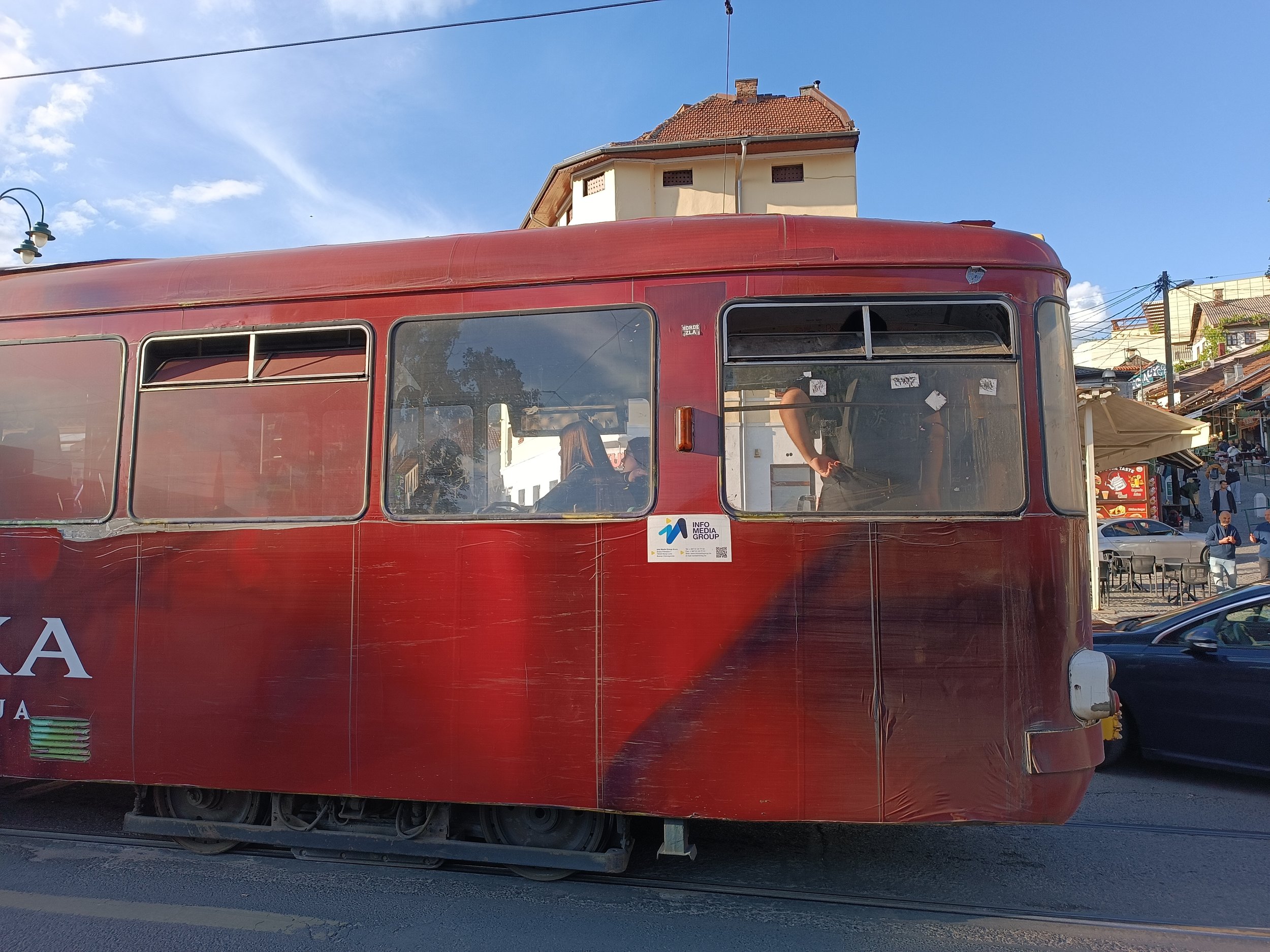
After a two-hour train journey, I arrive in Sarajevo // Bosnia, at dusk. I walk from the main station, which is located just outside the western part of the city centre, to my accommodation near the old market square. I pass first a main road, then a shopping street, turn slightly right at the Eternal Flame and continue along Ferhadija, which leads me straight into the old town.
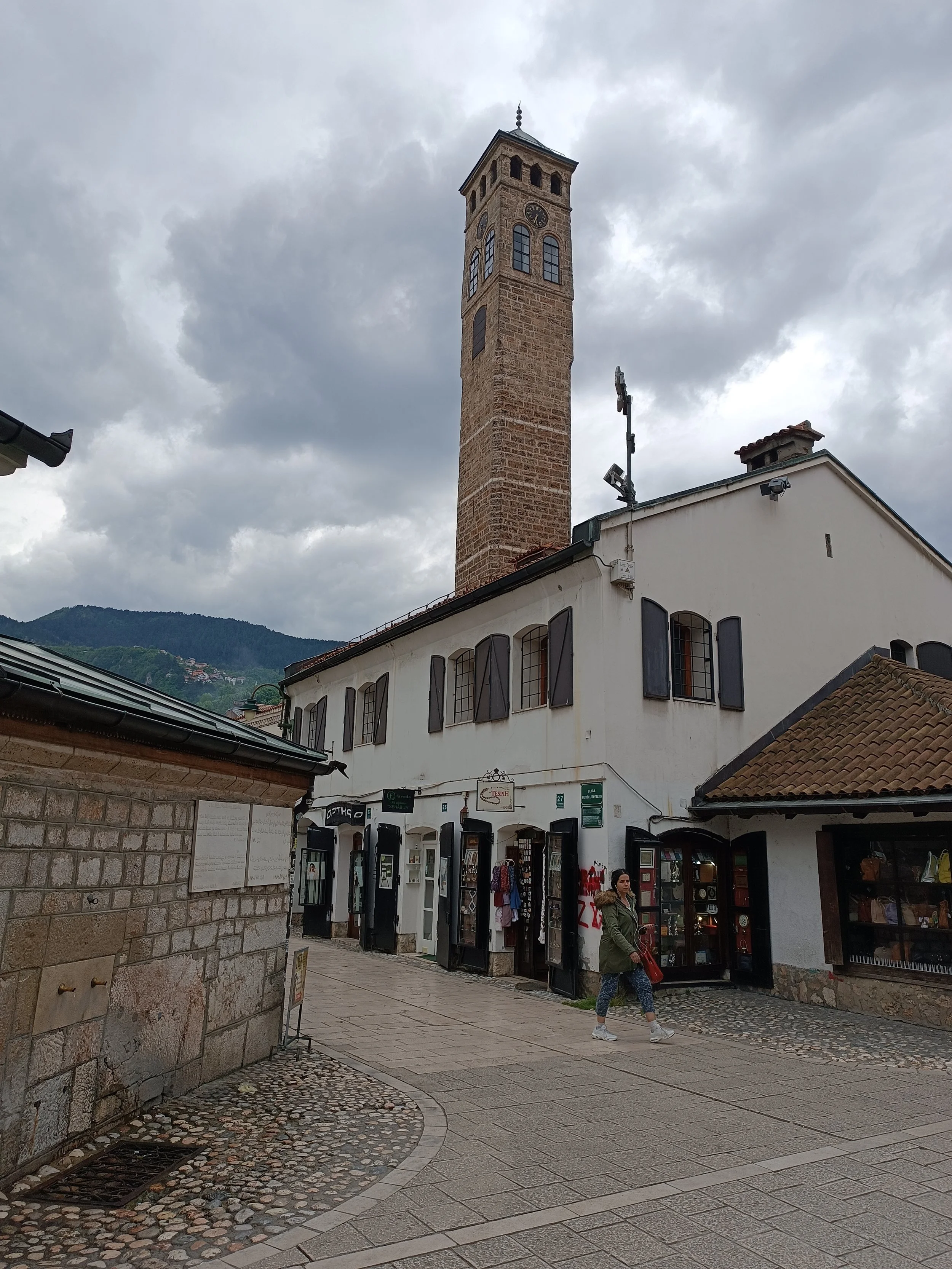
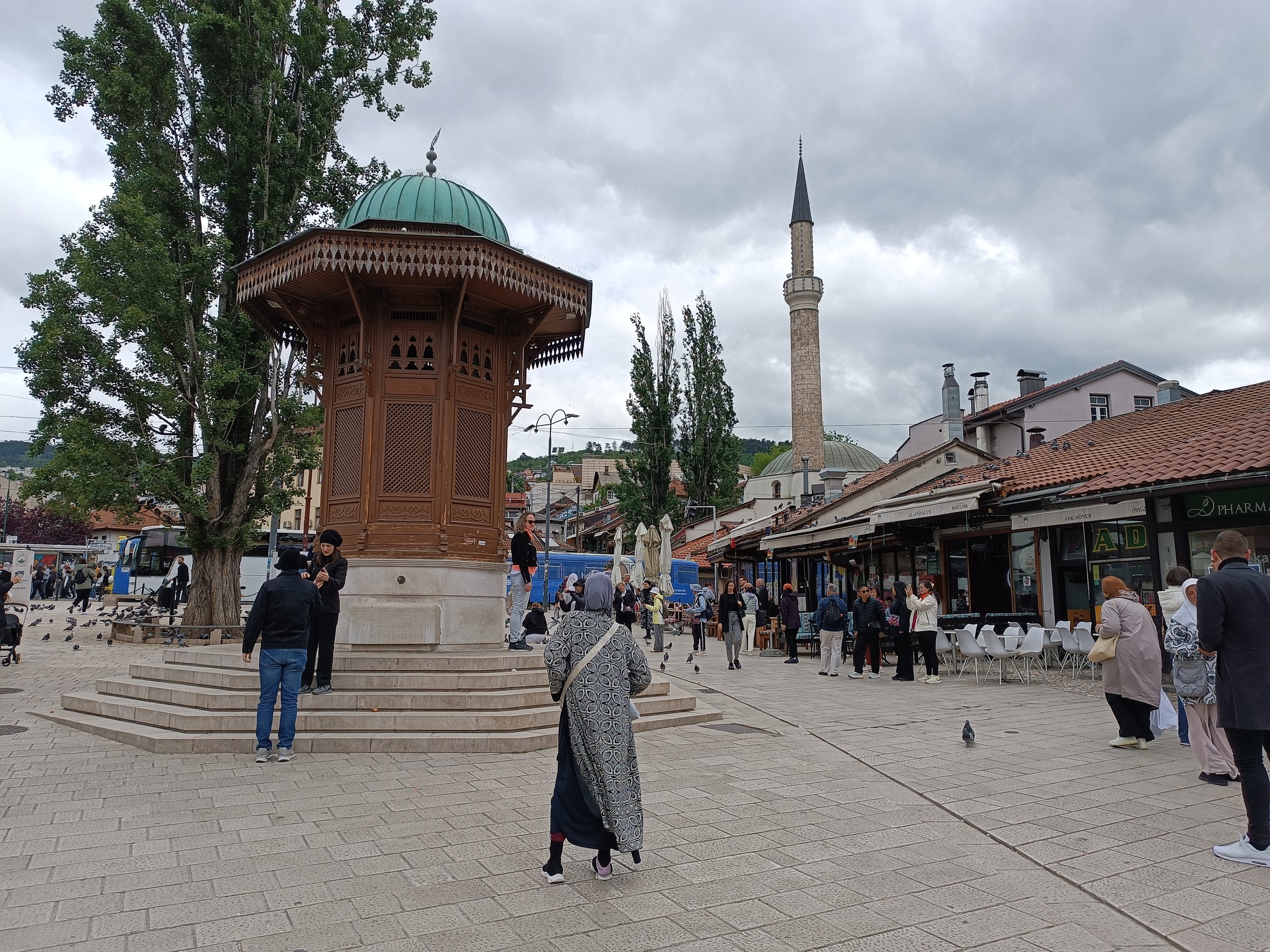
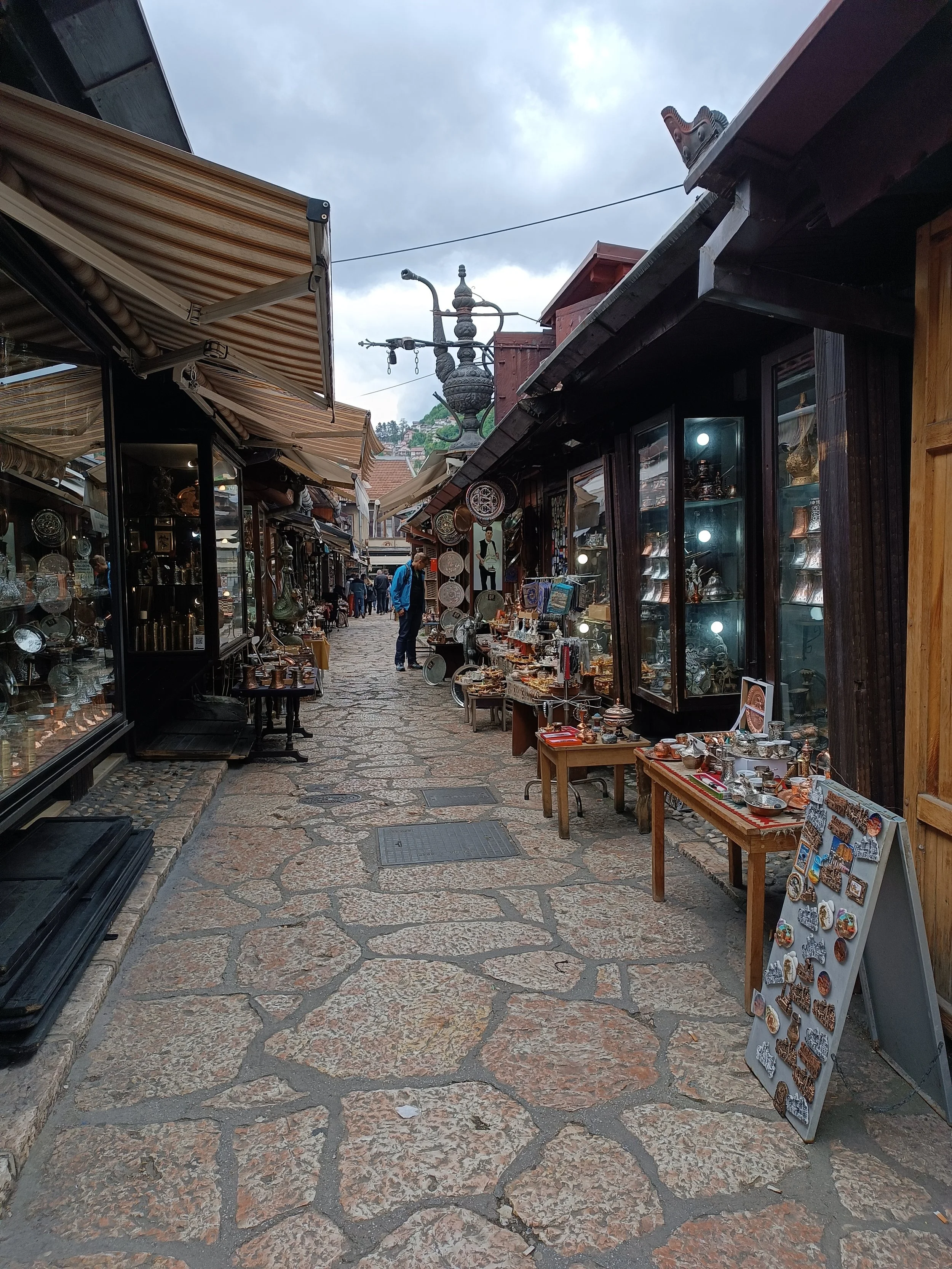
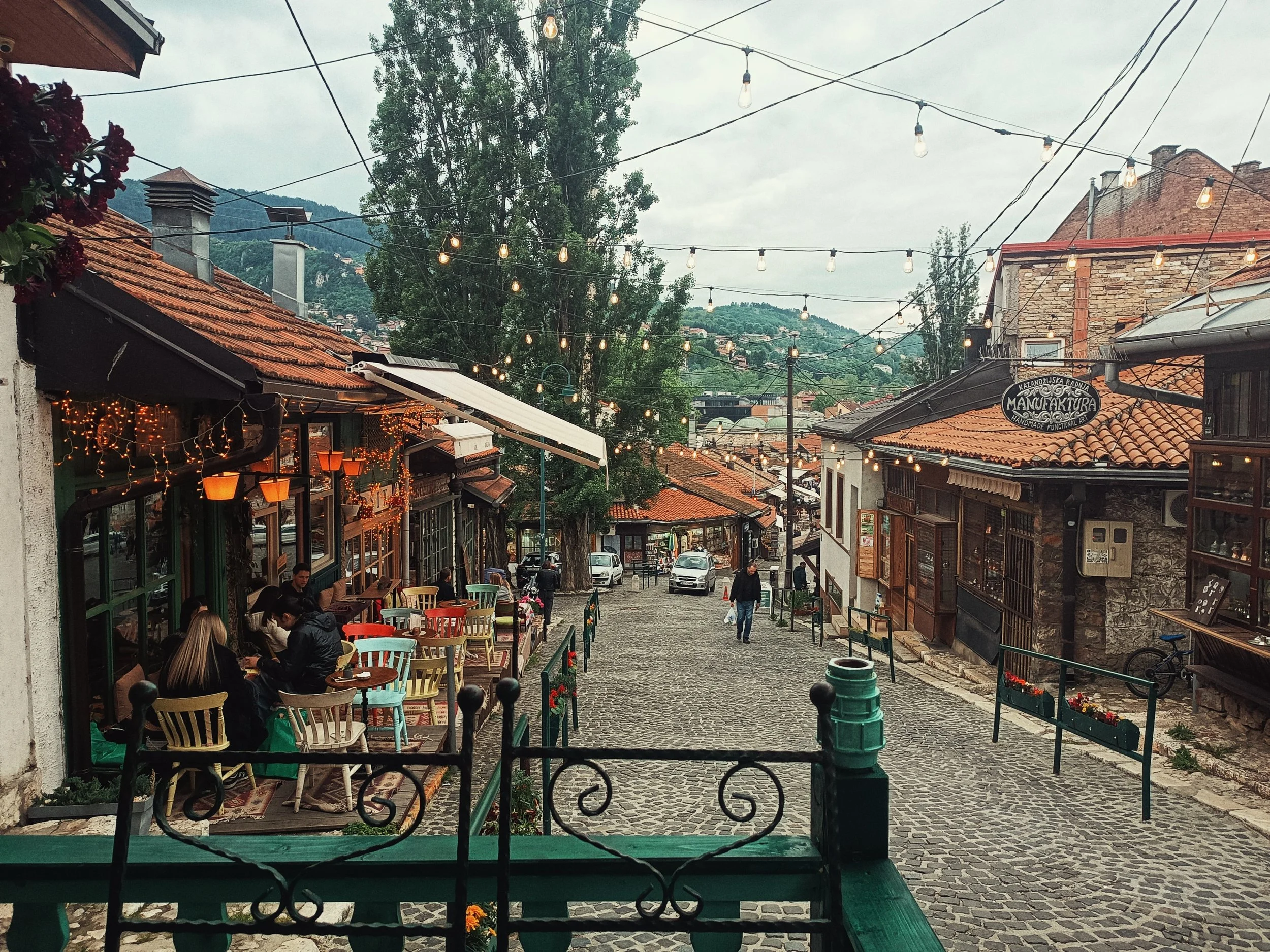
I immediately feel at home. But not just now, rather as soon as I cross the border, when I show my passport for inspection and the official murmurs a routine welcome after a quick check – the gate to an unknown world had been opened and I slipped happily inside. On the right a Serbian Orthodox church, on the left the Sacred Heart Cathedral, let’s go on, pass the Jewish Museum, Muslim life greets me on the right and left and everywhere. Mosques, madrasas, narrow artisans’ alleys and 16th-century warehouses, a former caravanserai and a thirty-metre-high clock tower[4]. I greet them back. Men sit in street cafés drinking tea. The muezzin calls for evening prayer.
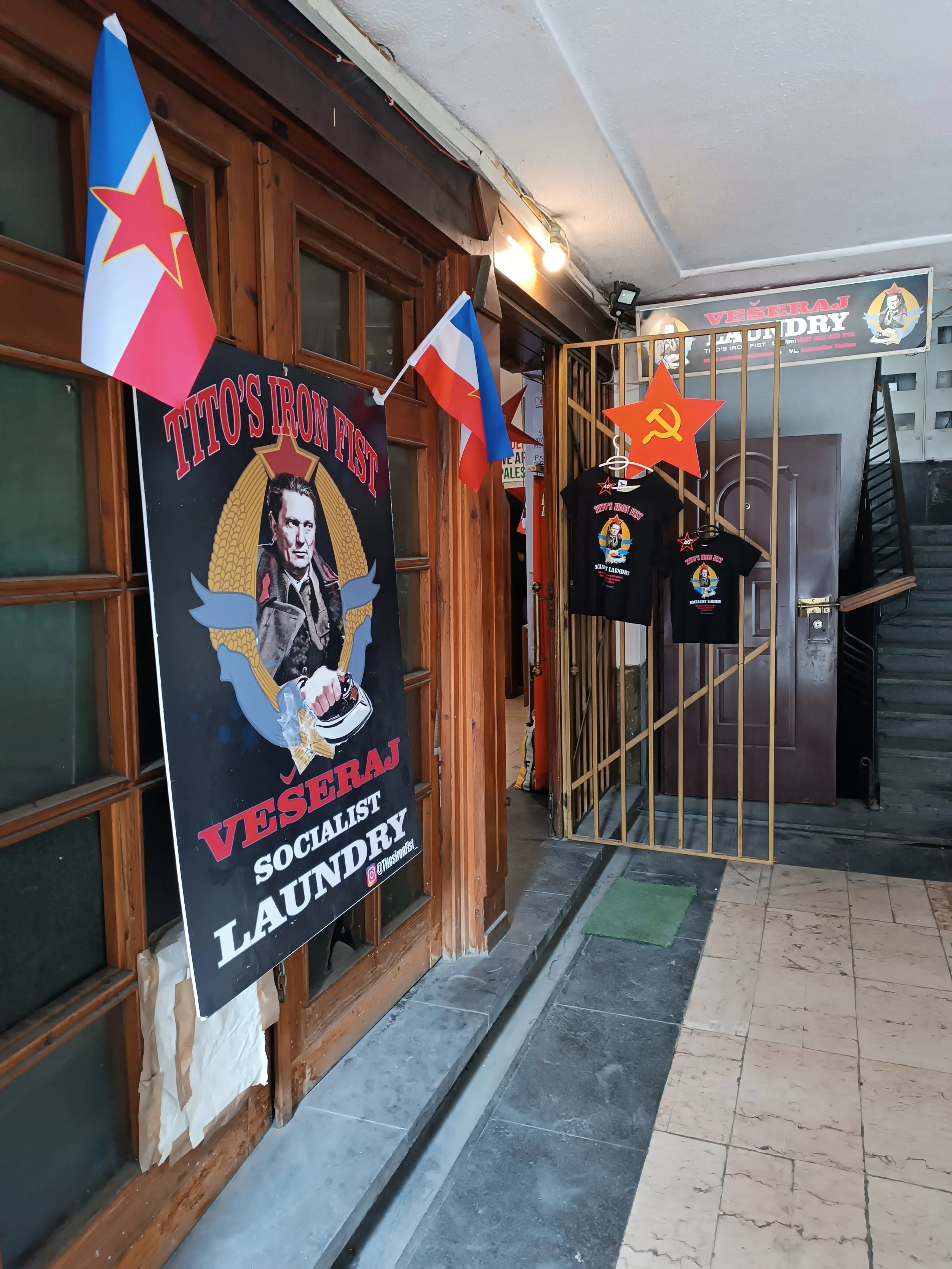
The next morning, I sign up for a free walking tour. We meet at noon on Susan Sontag Square[5] in front of the National Theatre. We are a group of eight people of various nationalities, plus me and Neno, our guide. He is about my age, later we learn that he lived through the siege of Sarajevo. But first, we wander through the past centuries – through the Ottoman Empire (from 1463), through the Austro-Hungarian administration (from 1878), through life in socialist Yugoslavia under Tito (from 1945). The city has incorporated all these eras into its architecture. The builders were skilful in their planning; Sarajevo is a beautiful city. The old town hall in its pseudo-Moorish style, the Art Nouveau houses, the Olympic bobsleigh track in the nearby mountains – everything is steeped in history and in stories. I hang on the narrator's every word, fascinated: how he talks about the beginning of the First World War on these streets,[6] the rising rents in the city centre and the new trams; how he refers about the national anthem and its missing lyrics, and about the local school system with separate classes, various textbooks and different versions of history. I want to hear much more, so I decide on the spot to also take part in the afternoon tour about the siege of Sarajevo. In between, I quickly pop into “Tito's Iron Fist Socialist” laundry. Pictures and mementos of the former president hang all around. I was already here this morning. At that point, there was no water available, so I left my laundry with the friendly shopkeeper. The water is still not running, he apologises, explaining that he is now working with canisters, and offers to bring my laundry to my accommodation later. I decline, saying that is not necessary, I will come back, please do not trouble yourself. His hands are reduced to stumps.
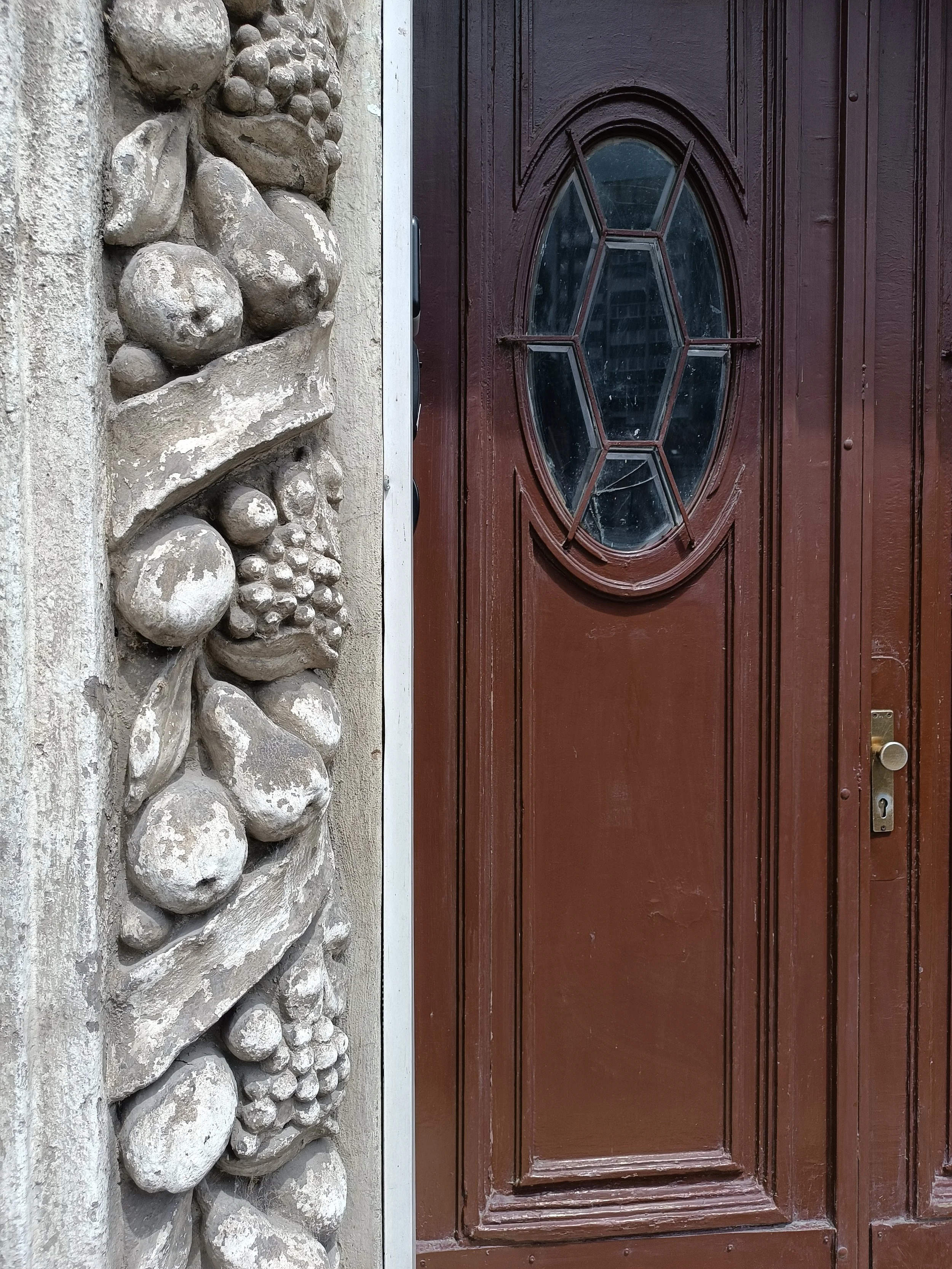
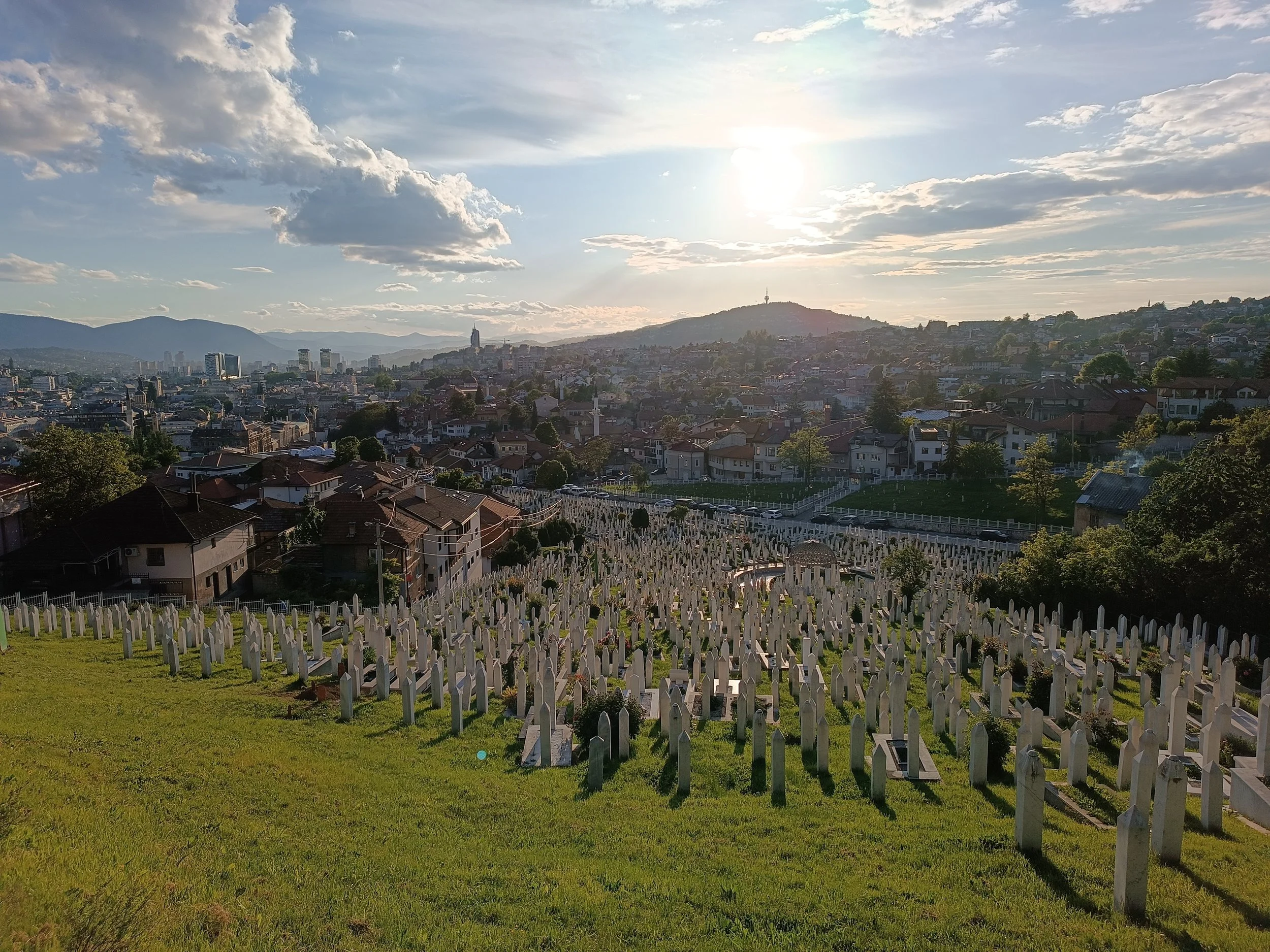
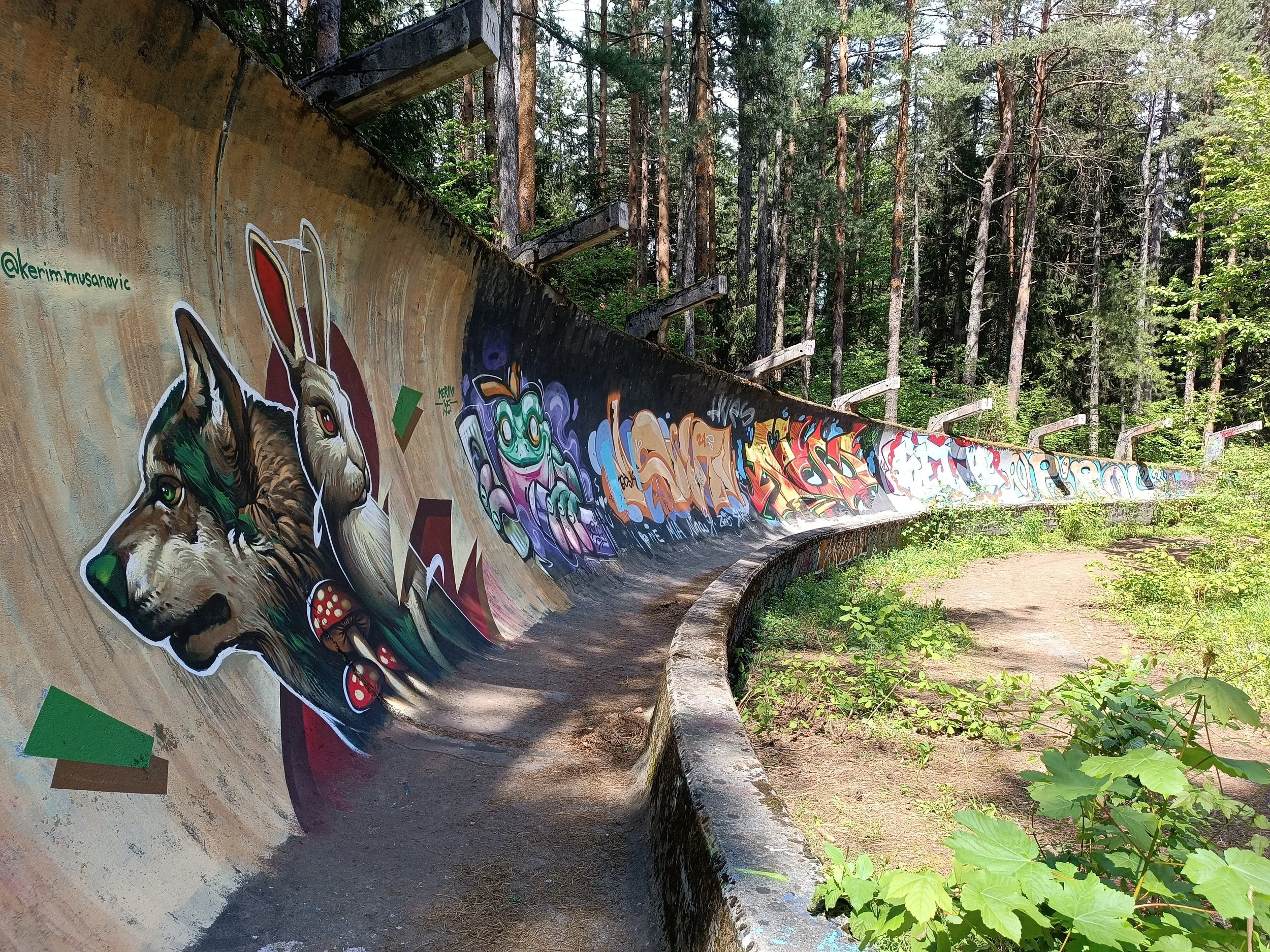
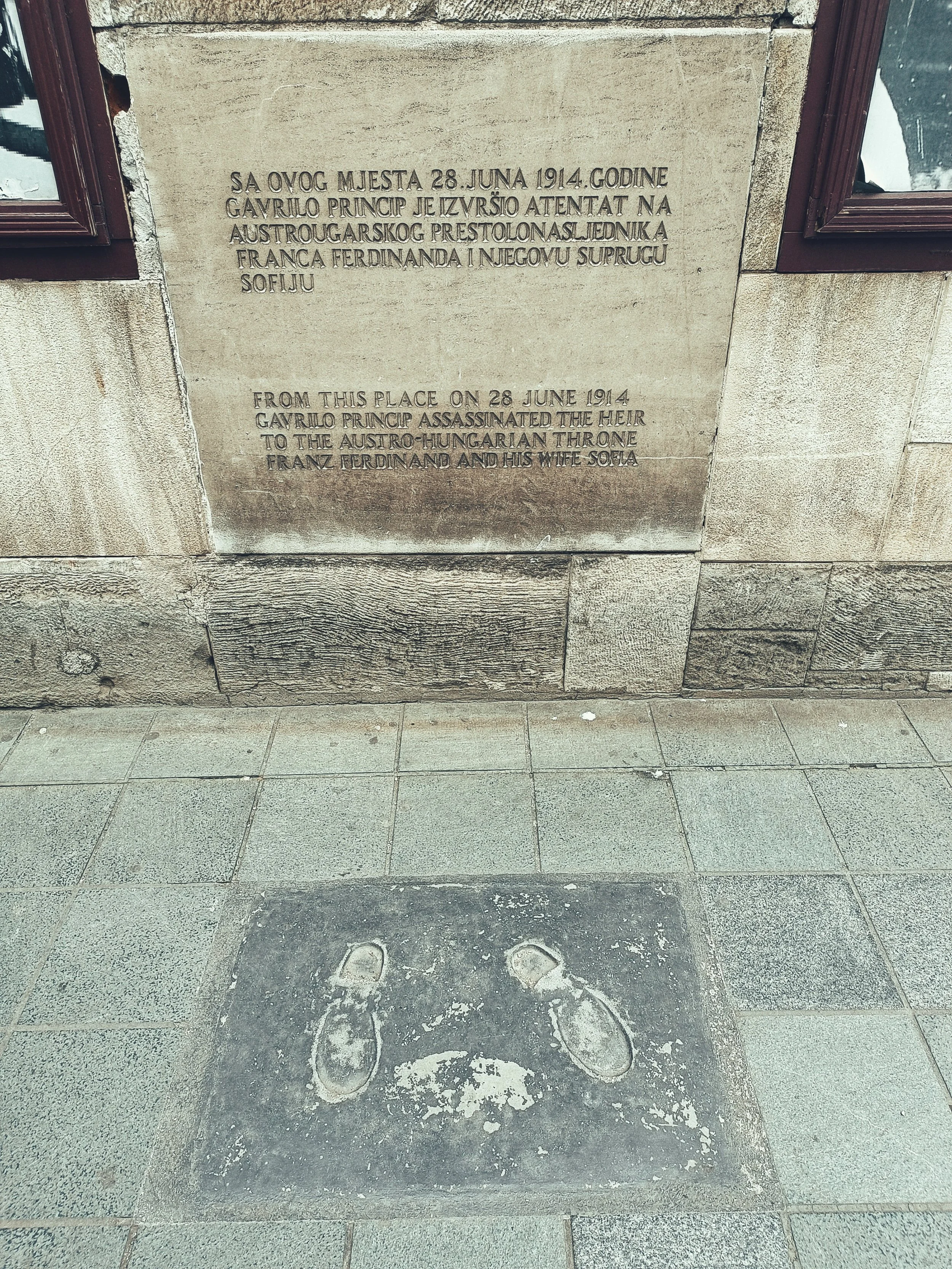
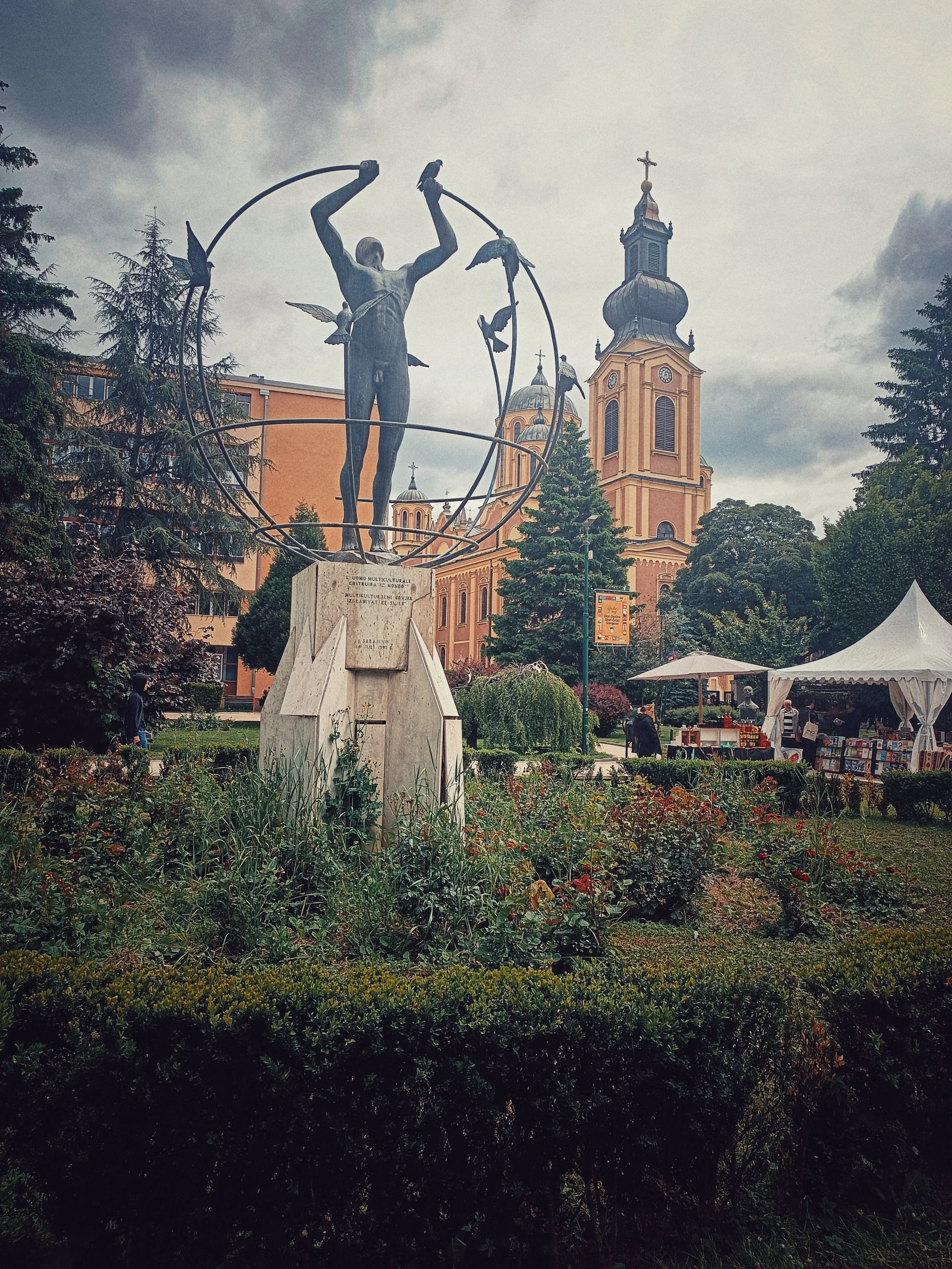
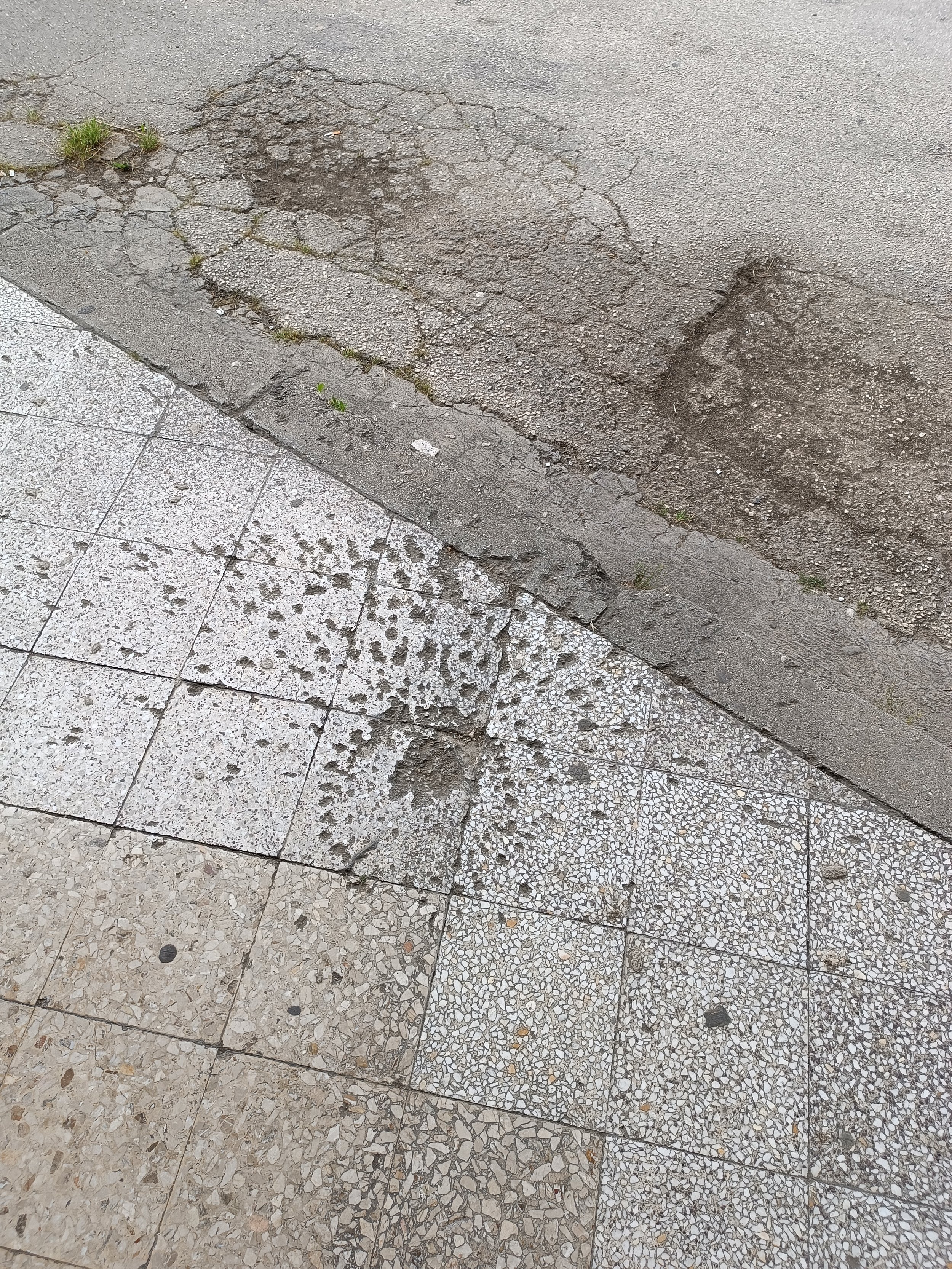
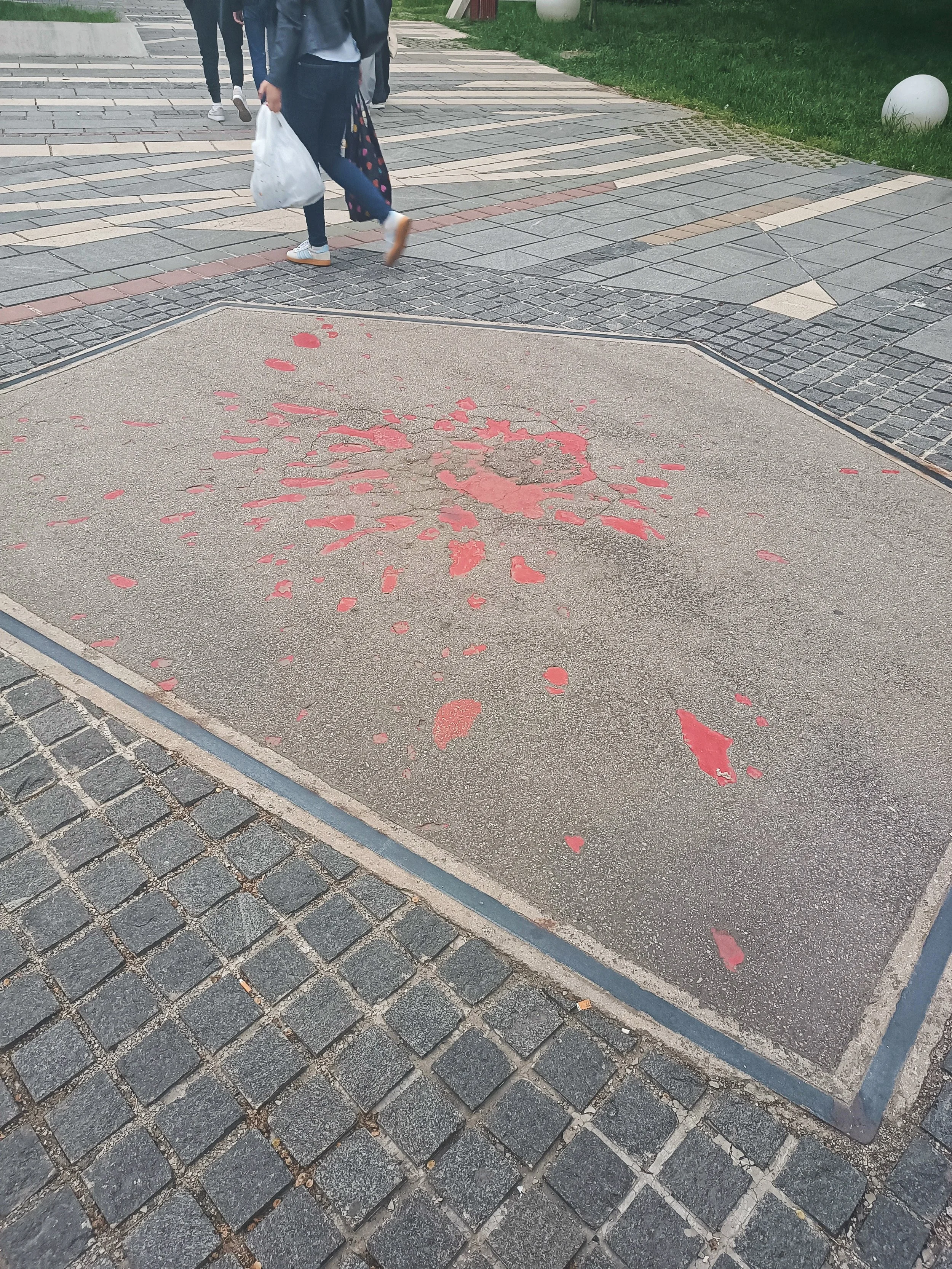
The second tour is much more difficult. The weather creates the right atmosphere, with icy winds sweeping down the mountain slopes into the city's valley basin. From these slopes, Sarajevo was besieged from 5 April 1992 to February 1996 by Bosnian Serb units who wanted to prevent Bosnia's independence and create a Greater Serbia instead. 1,425 days. Capture of the airport, occupation of urban areas, “ethnic cleansing”. More than three hundred grenade strikes per day on average; on 22 July 1993, there were more than ten times that number. Snipers from surrounding buildings shoot at the civilian population.[7] People without sustenance, people without electricity. Children without a future. Ten thousand dead, fifty thousand injured. And the survivors. Hidden in cellar cubicles, in shelters and half-bombed houses. But who can survive in the long run, facing horror every day? Neno also describes another side of the war: theatre performances, exhibitions, concerts[8] as an act of self-empowerment, an expression of humanity. Neno was lucky, because he and his family survived the siege relatively unscathed. How many were not so fortunate! How many still bear their wounds, visible throughout the cityscape or invisible in their hearts. Later, I thank him for sharing his memories with us. The siege of Sarajevo ends with the Dayton Agreement[9]. To this day, the shell craters mark the paths of the city, some dressed up as roses so they will not be forgotten. The past is ever-present.
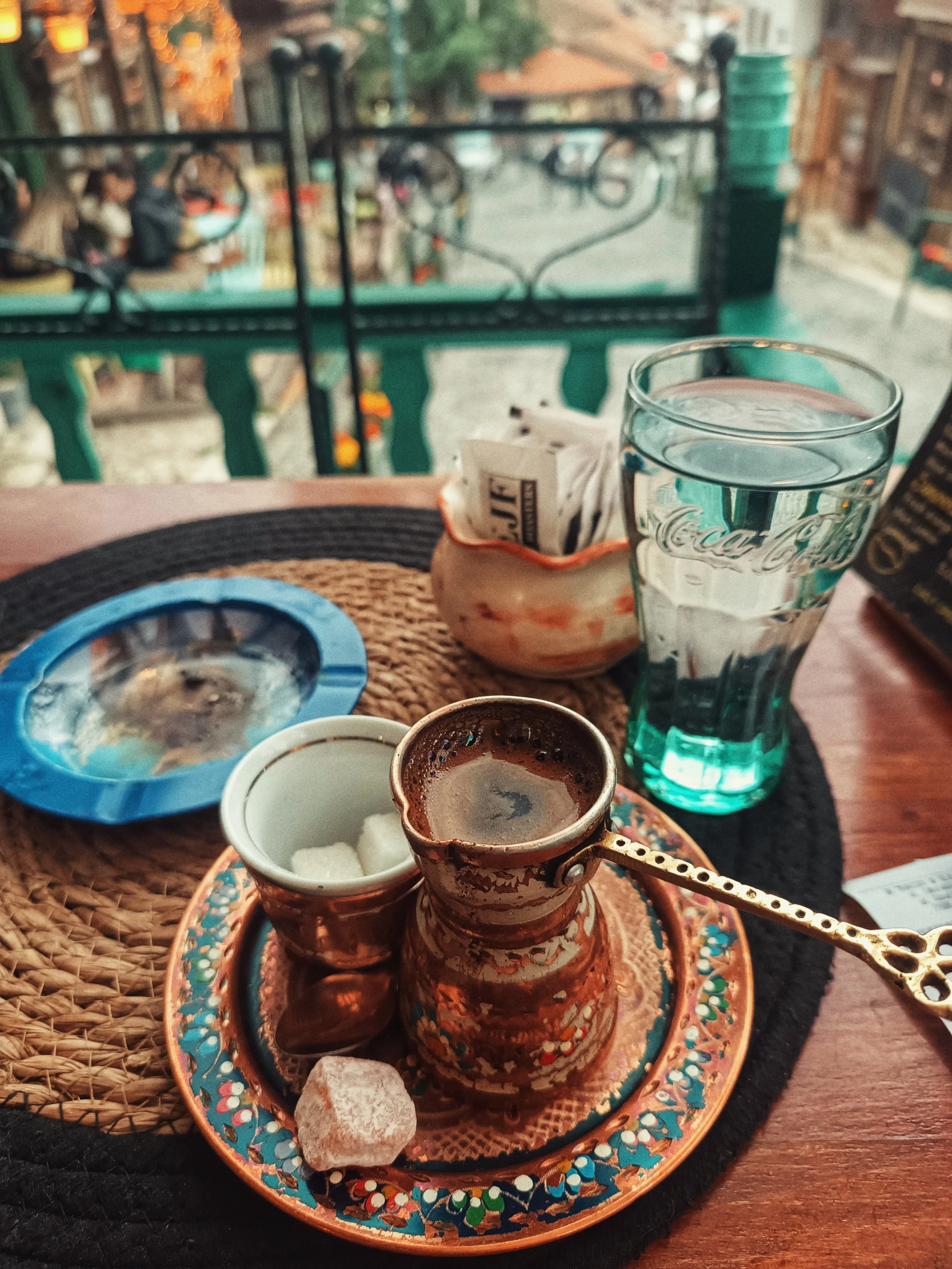
In the evening, I have a video call with my boyfriend and give him a detailed recap of everything I've experienced. Travelling solo feels different when you're with someone else. I still think about this the next day as I sit on the outdoor terrace of a café, sorting my thoughts over a strong Bosnian coffee – the mocha is delicious. Suddenly, I catch a melody drifting out from inside through the small crack in the door. It's Whitney Houston singing I Wanna Dance with Somebody.
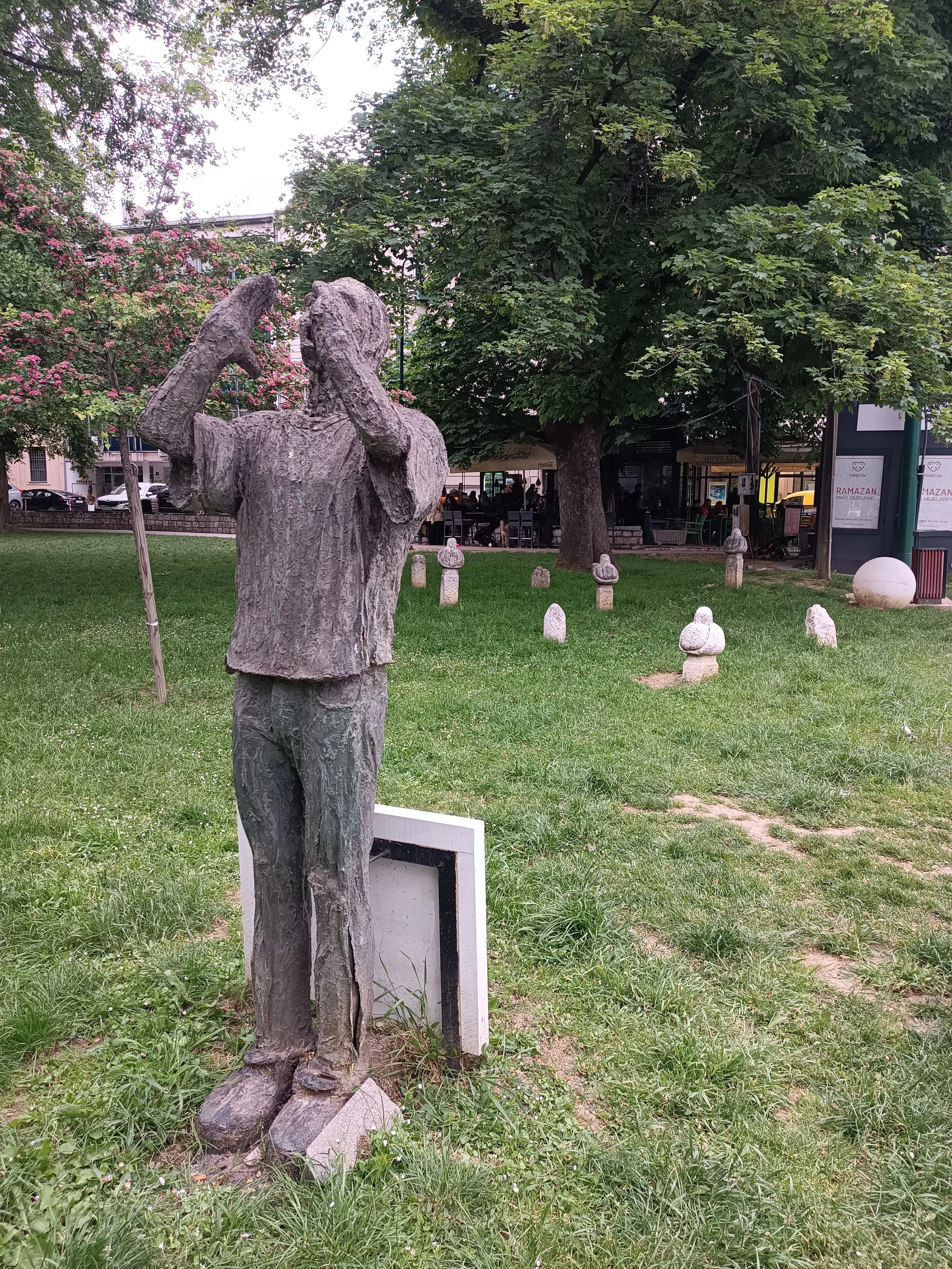
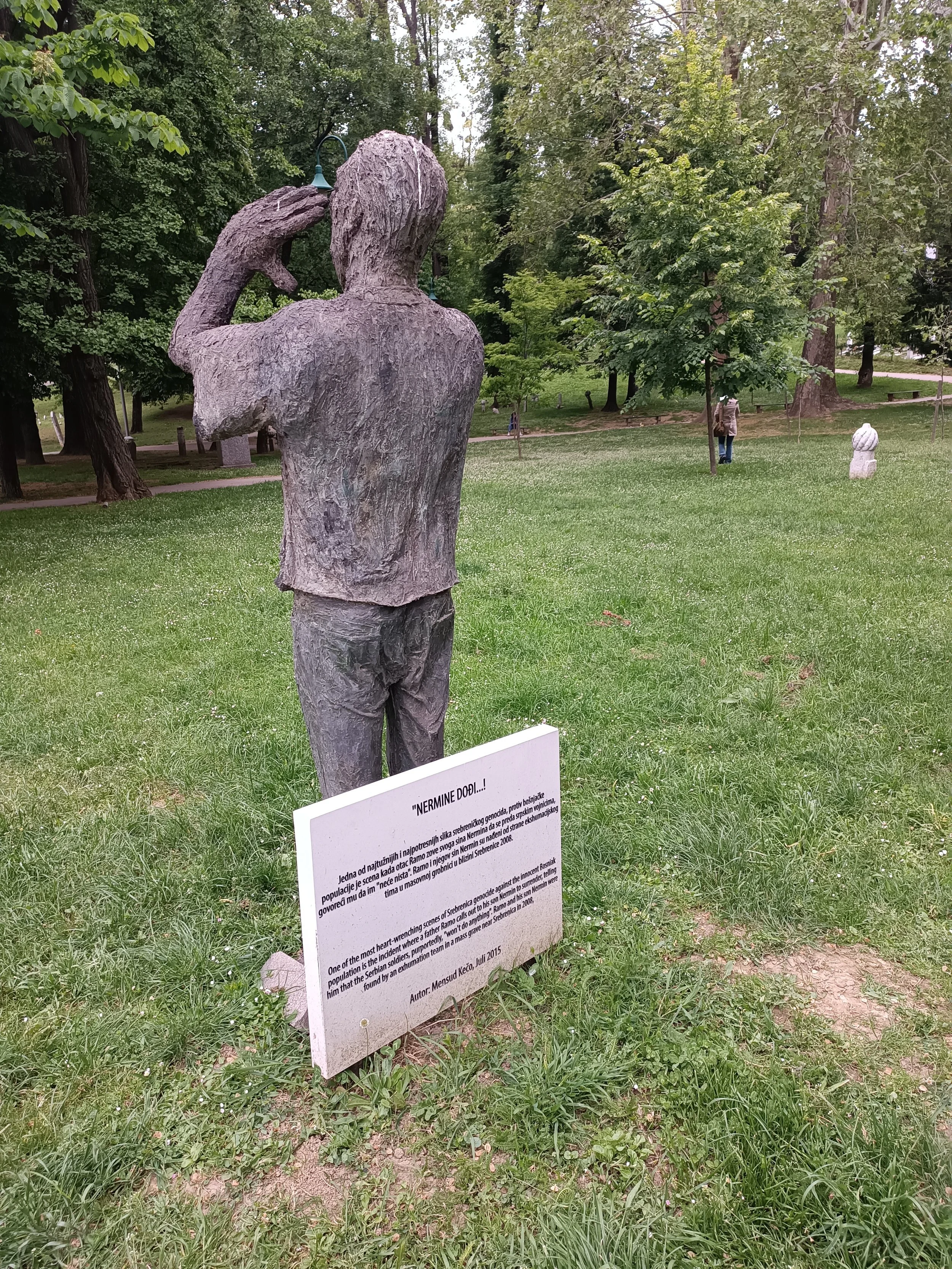
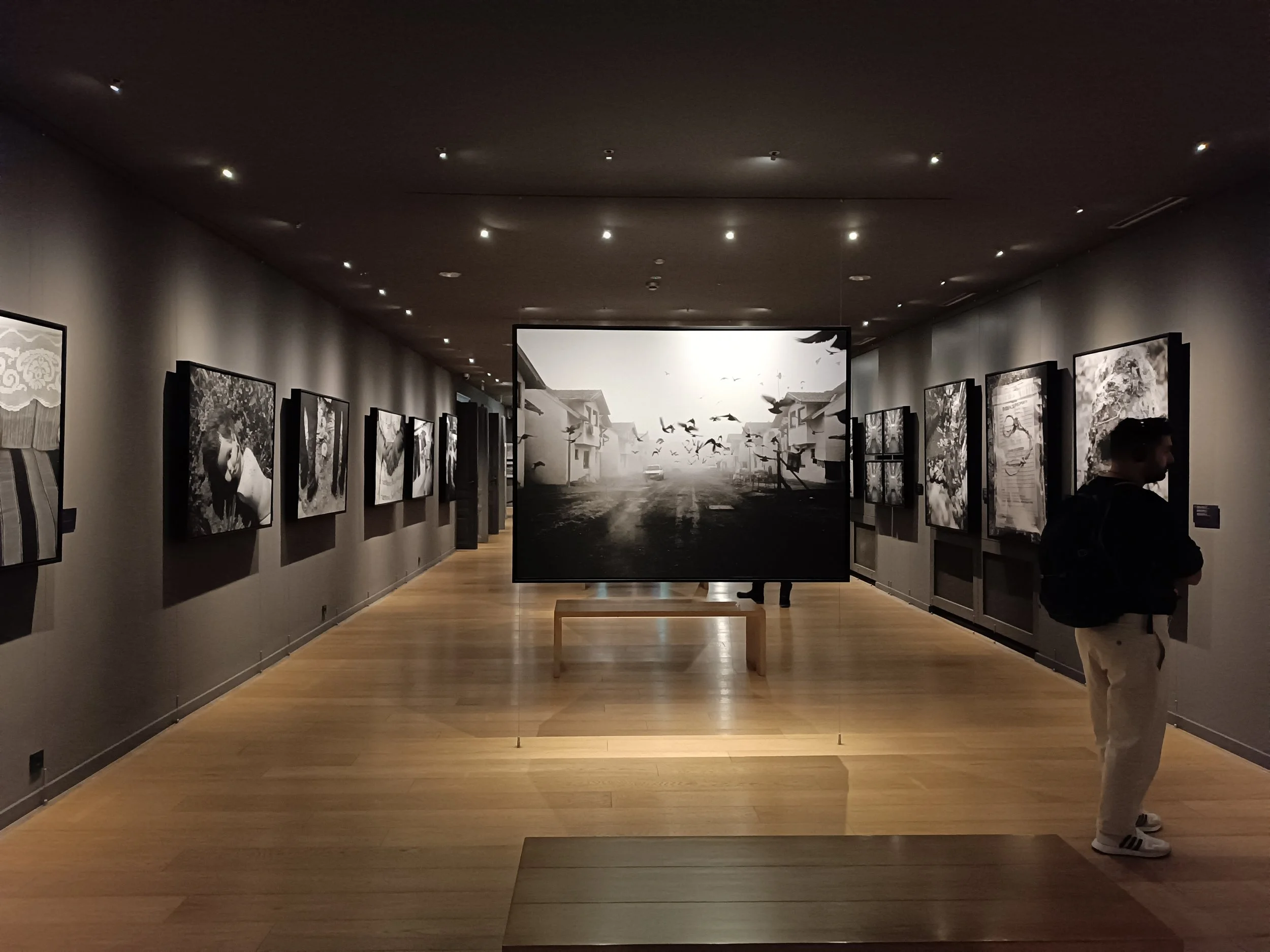
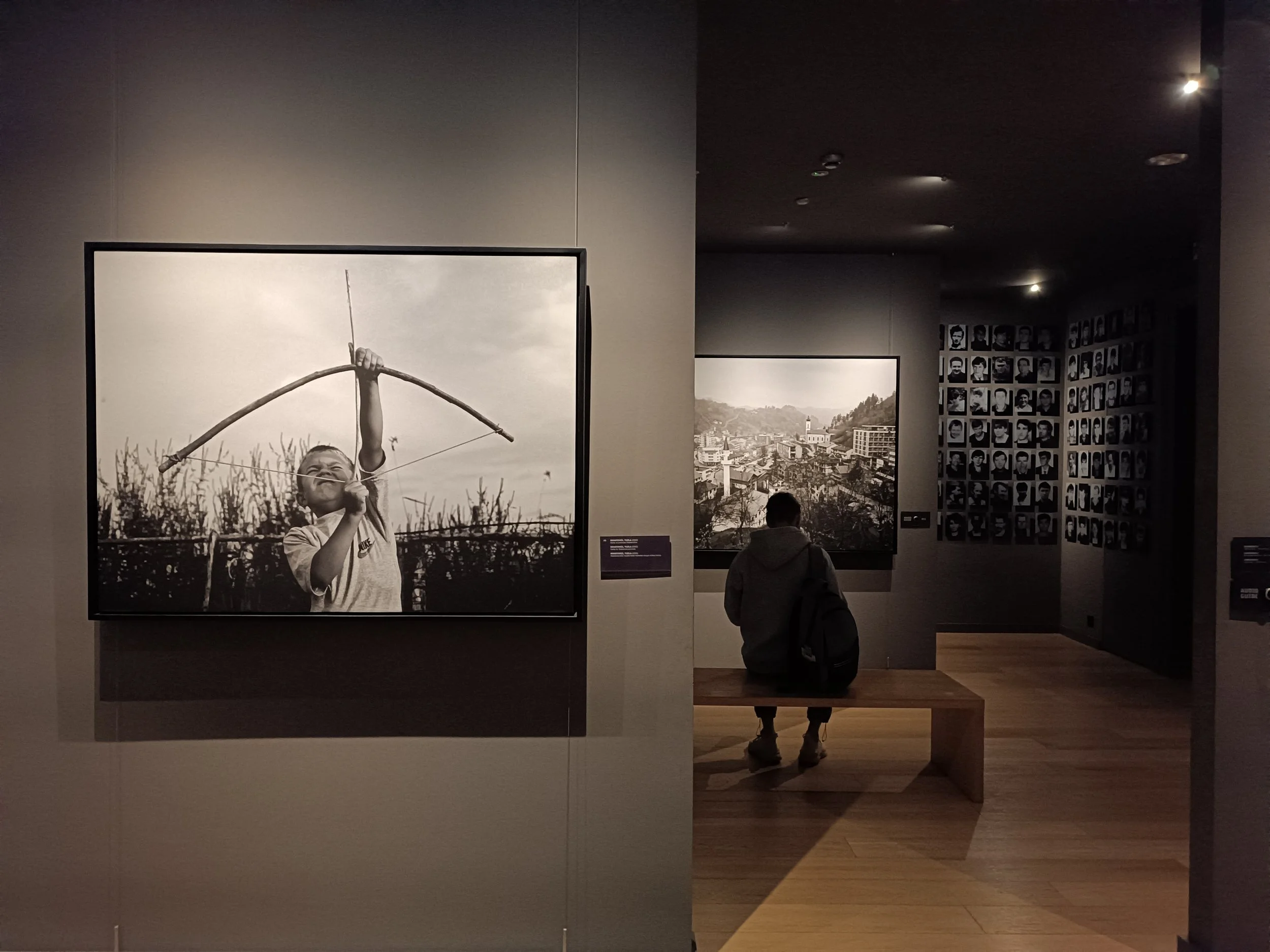
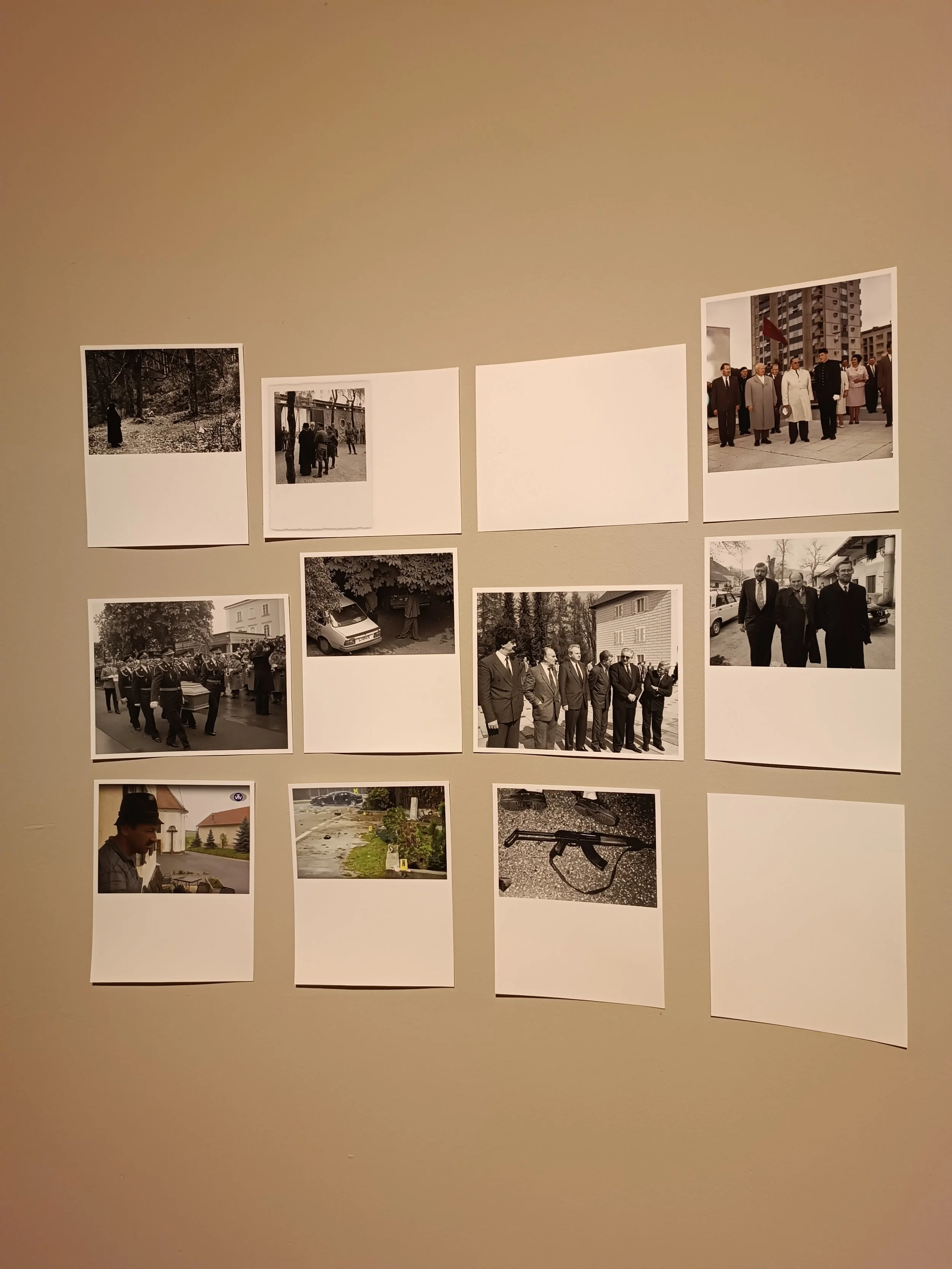
I realise just how heavy history weighs when I visit Galerija 11/07/1995. It is a memorial site that tells the story of the 8,372 Muslims who lost their lives in the Srebrenica genocide[10]. The exhibition is located on the third floor of what I assume was once a residential building. The names of those murdered are displayed in the hallway, followed by 640 small portraits in the entrance area. I buy a ticket and take the audio guide. At the start, you can choose between a short and a detailed version of the individual contributions;
I choose the detailed one. I want to know everything in order to understand. There are only a few visitors with me in the museum, and we leave each other in privacy. Shielded by my headphones, I immerse myself in the events of thirty years ago. I go from one photograph to the next, drawn to the haunting black-and-white images from Tarik Samarah's series “Srebrenica – genocide in the heart of Europe”.[11] At the same time, I hear the stories of Hasan, whose brother was denied protection by UN peacekeepers; of Ramo, who calls his son down from the mountains. Nothing will happen to you; he shouts on the orders of the Bosnian Serb military. Neither father nor son survive. Neither does Hasan's brother. I hear shocking details about the exhumations and, for the first time consciously, the words primary, secondary and tertiary mass grave. 94 mass graves have already been excavated and 6,900 victims identified.[12] I creep, I sit, I freeze. I listen to some parts of the audio guide
a second time. I fight back the tears as they silently roll down my cheeks. It is almost unbearable, but I must. We must face history, to prevent forgetting. Now I move on and watch moving images on a television. Historical footage and interviews with women who are still searching for their dead husbands, for their sons. Who, torn by grief, cannot cope with not even having been able to say goodbye. When a scene is shown in which a father, weeping bitterly, covers his dead child with a blanket, I too lose control. The silent flow of tears overflows all banks; I must get out of here.
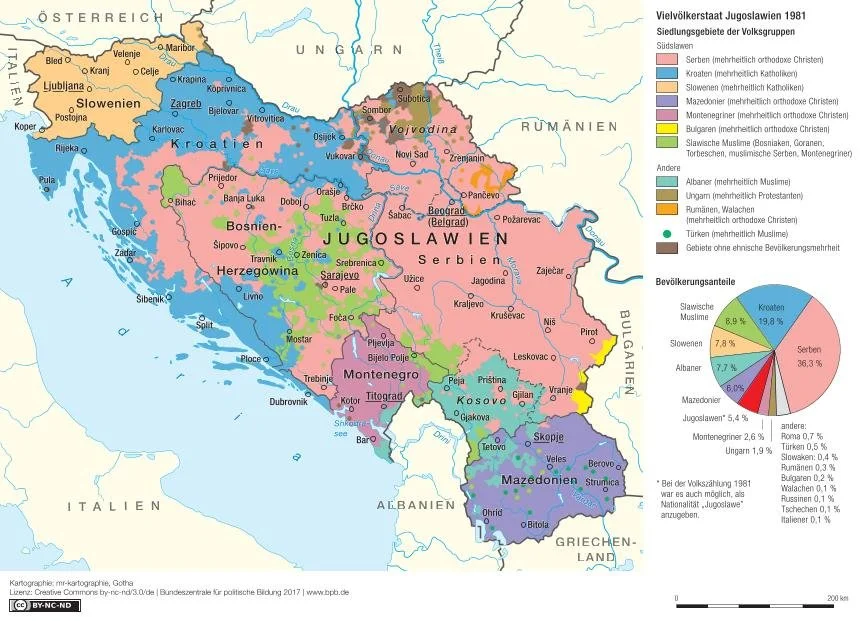
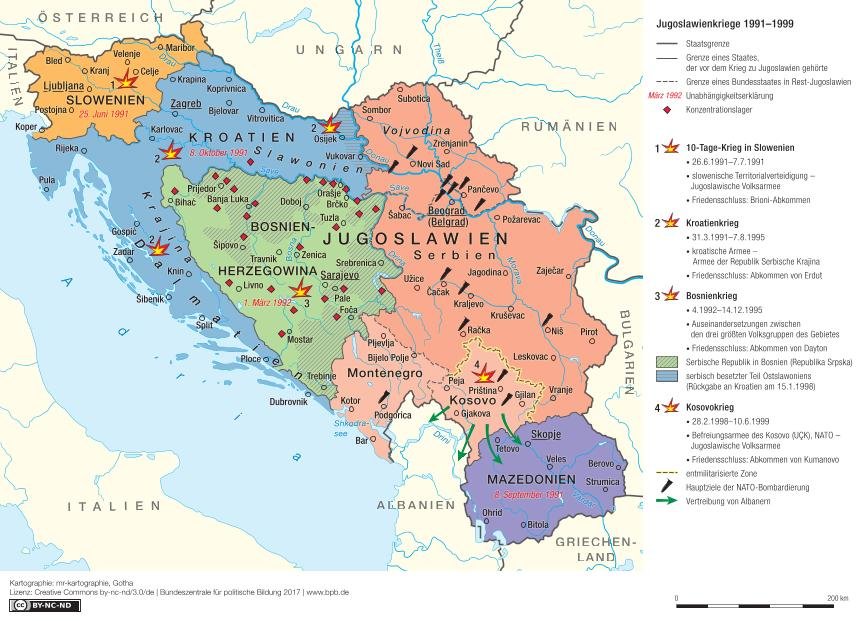
Let me summarise. With the break-up of Yugoslavia and the declarations of independence by its republics, the Balkans once again become a powder keg. Nationalism grows stronger also in Bosnia. Ethnic groups that once lived together in a multi-ethnic society now fight one another. Old and new images of friends and enemies are exploited for political purposes: initially conjured by those in power, these images then infiltrate large sections of the population. Former neighbours and schoolmates become the other. It is us against them. But no one knows exactly who “they” are, and later, no one even knows who “we” are. This is where the perversity of war begins.
It is 3:30 p.m., I am sitting on the bus to Banja Luka, heading for the north of the country. I have five hours ahead of me. Great! Just me and my book (Catch the Rabbit) and my travel diary. Music. No data. It feels so good to be offline on the road, less distraction.
An old woman sitting to my left is eating saltine crackers. I kind of like how she's sitting alone on the bus, snacking her crackers. Sometimes she chokes a little, then clears her throat and takes a sip of water. What stories could she tell me?
These mountains are breathtaking. The Dinaric Alps, I think. Unfortunately,
I didn't manage to get out into nature, to the villages. Slightly disoriented in my travel planning, time ultimately slipped through my fingers.
Oh no, now her bag of crackers has fallen, and some are scattered on the ground. Triangles, squares, circles. Next to them is a peanut flip – it must have fallen out of someone else's bag.
Cemeteries in many places. White stones surrounded by green grass. The world passes by.
We follow a river that meanders. It copies the letter U. “Copy”, I smile, the river has probably been there much longer than the U. How beautiful it is to look at. What is your name, winding river?
And now my water has leaked! It drips down the seat. A young woman behind me kindly points this out to me. Now I feel connected to the older woman; we share misfortunes. Meanwhile, the bus driver smokes a cigarette comfortably by the open window.
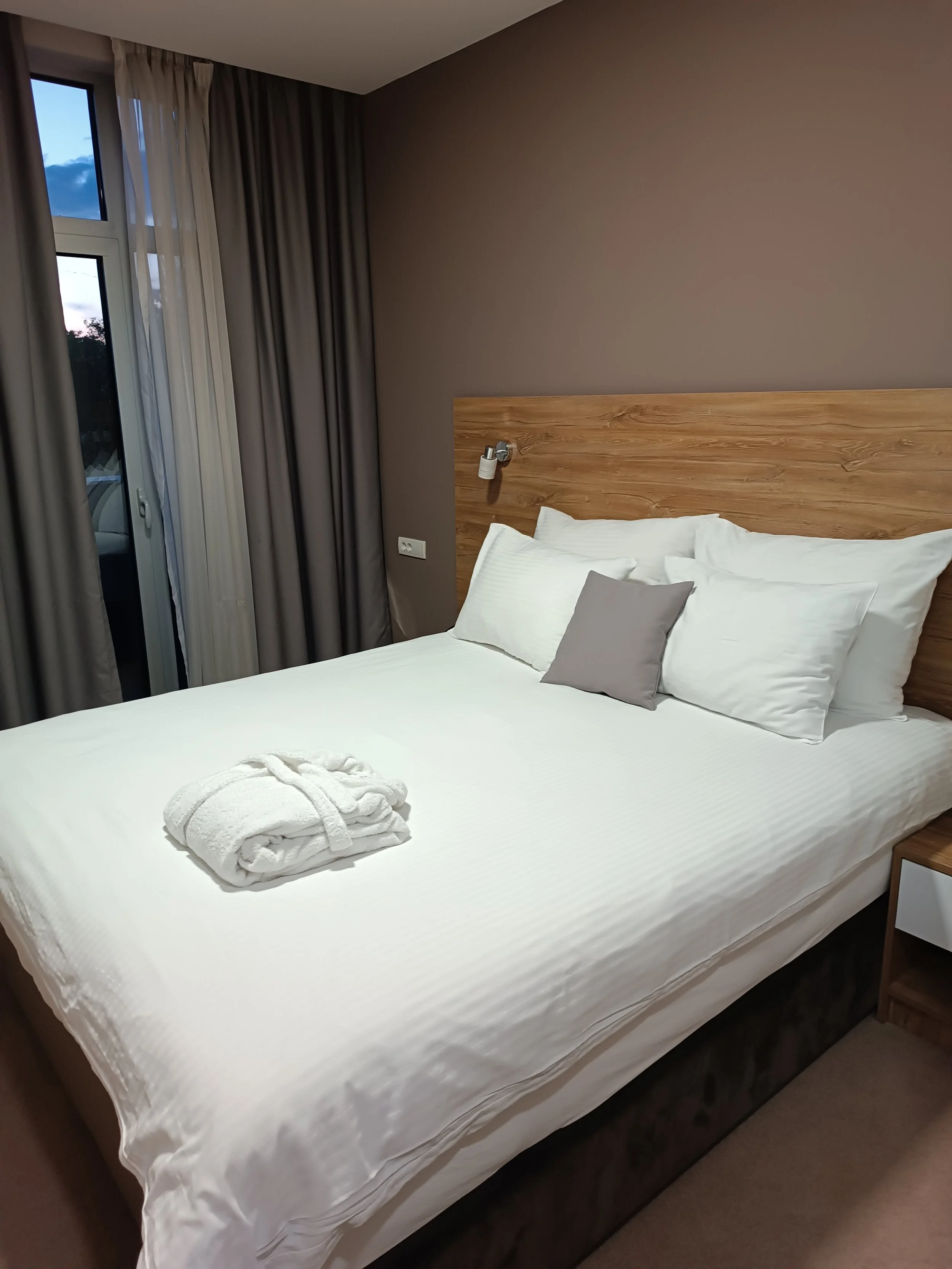
It is already getting dark in Banja Luka // Republika Srpska. For practical reasons, I booked accommodation near the bus station. The area seems rough, but my hotel room is perfect. In the end, I decided to treat myself to a little luxury, which immediately welcomed me with a wink. A double bed with lots of pillows in crisp white linen has been made up for me, a bathrobe lies carefully folded on top, and a large bathroom awaits just me. Okay, I take a shower, slip into the white fluff and jump into bed. The night is dreamless.
Scrambled eggs for breakfast, then I walk into the city centre. Everywhere
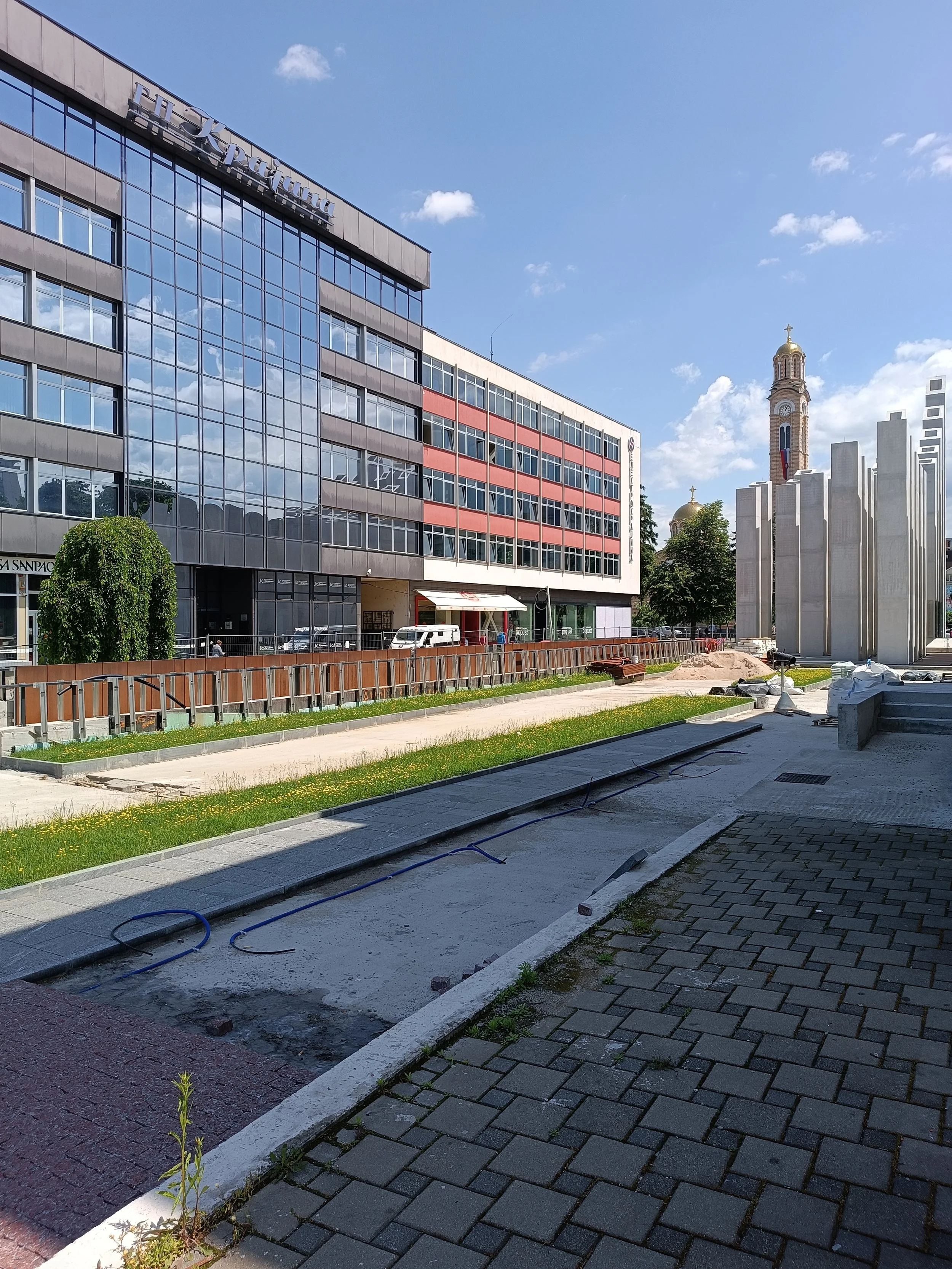
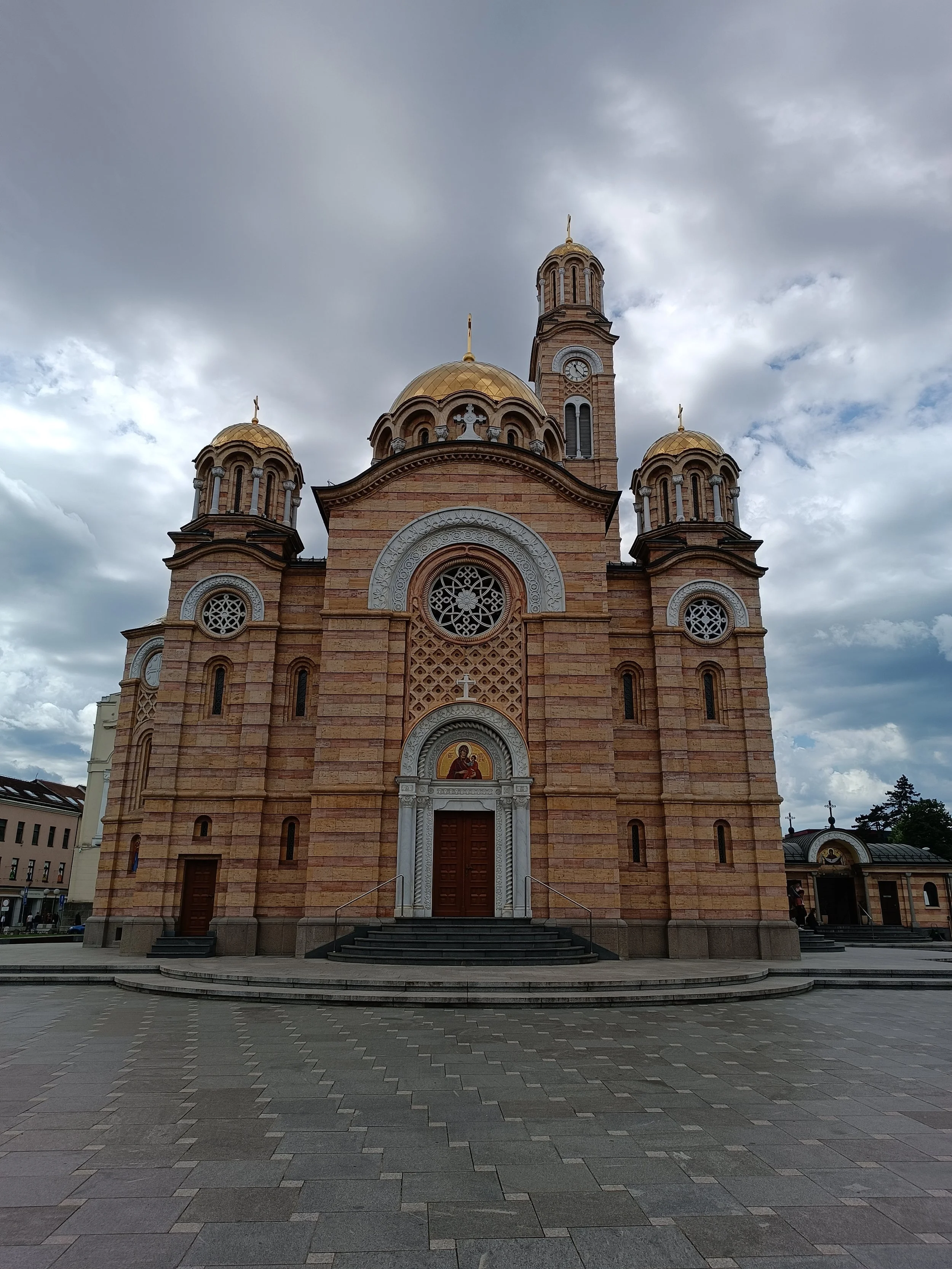
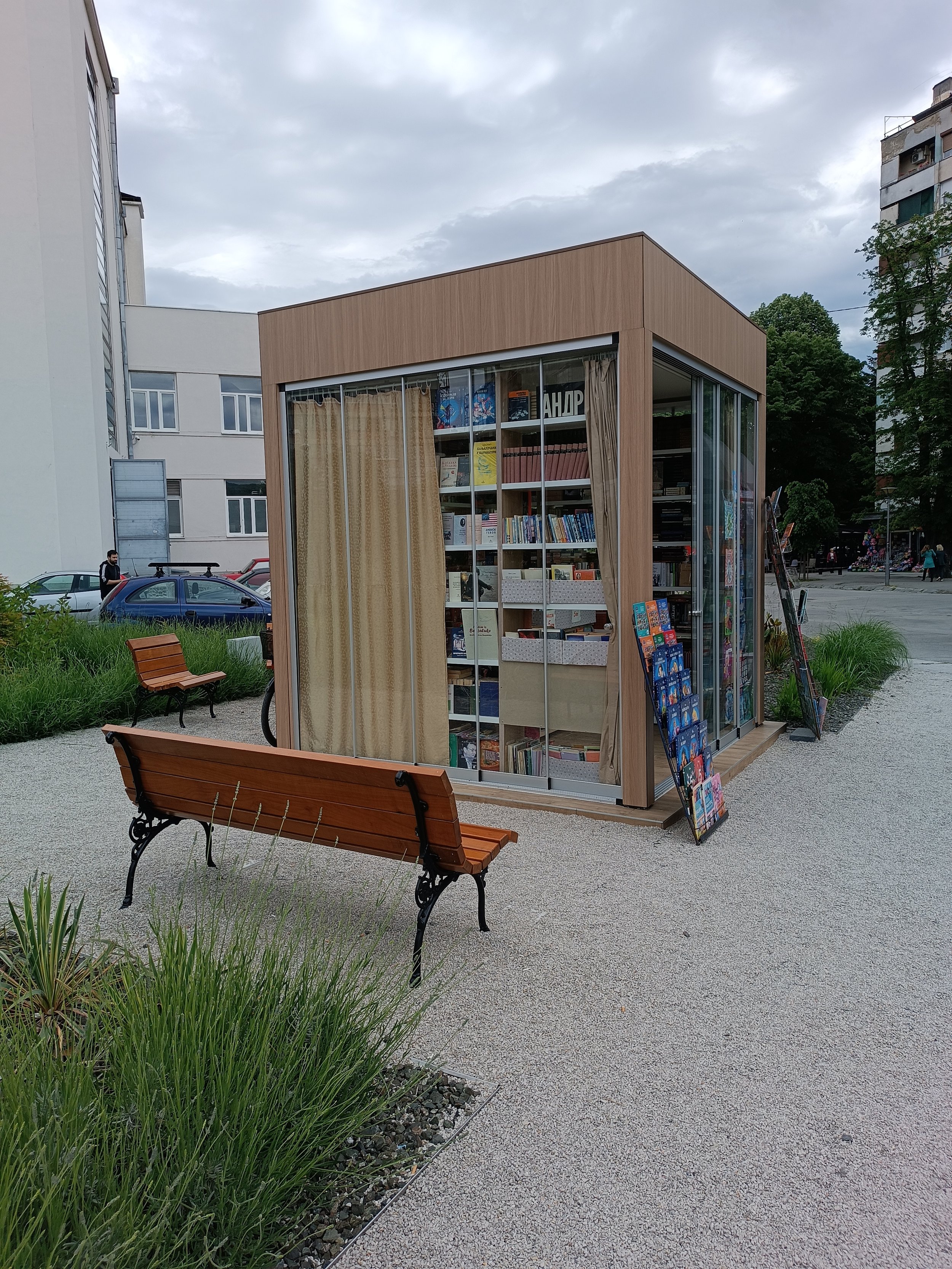
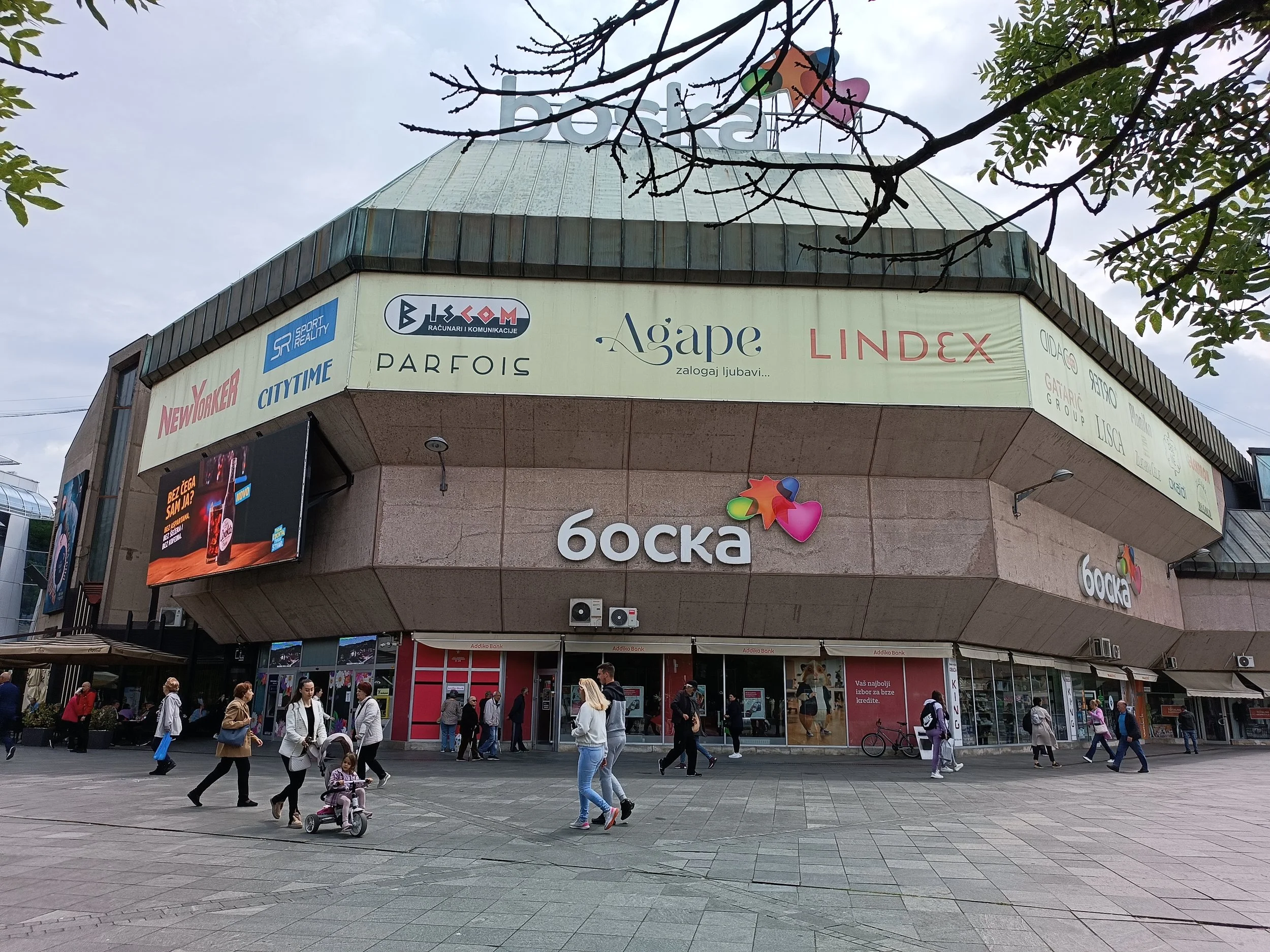
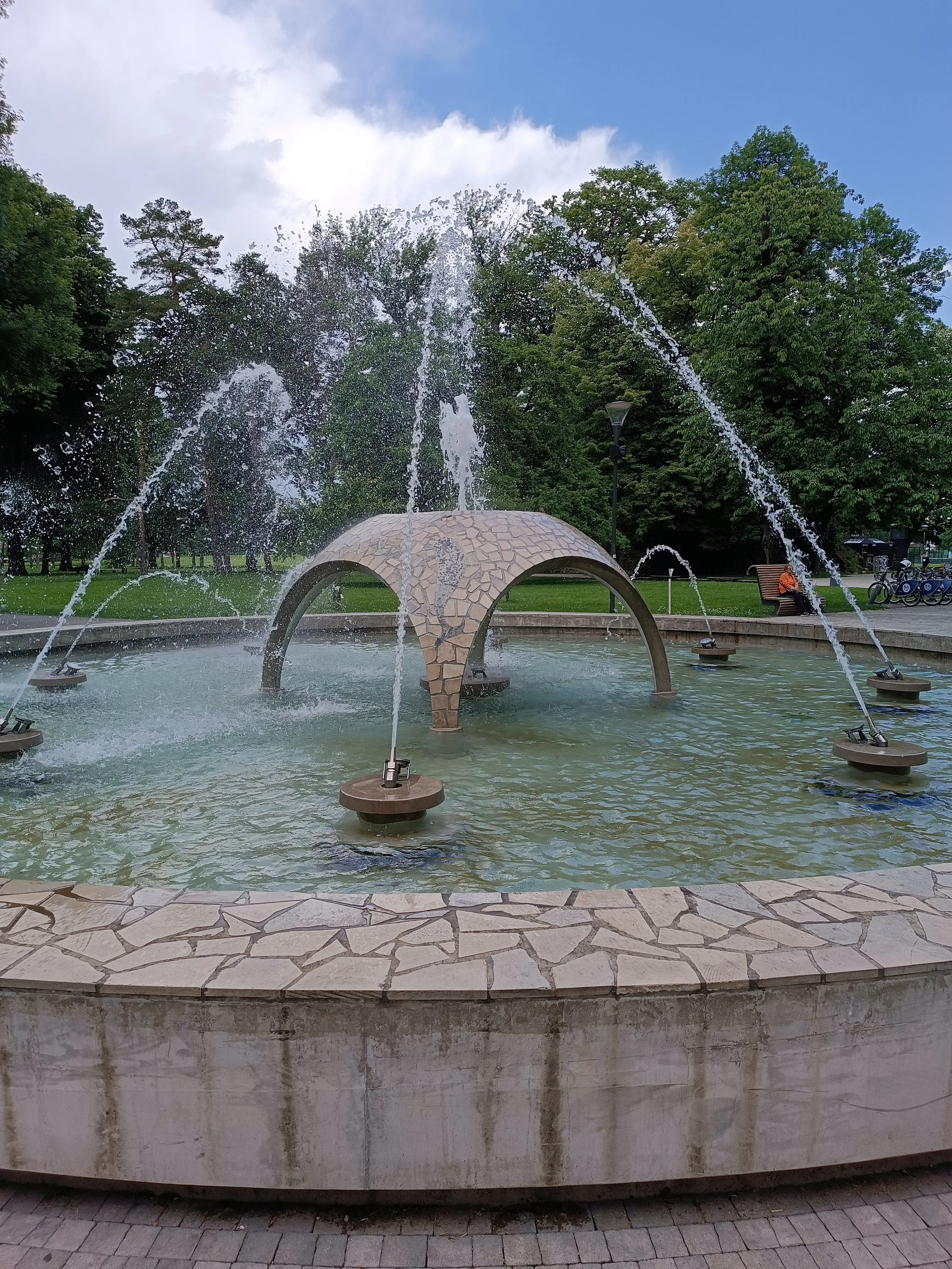
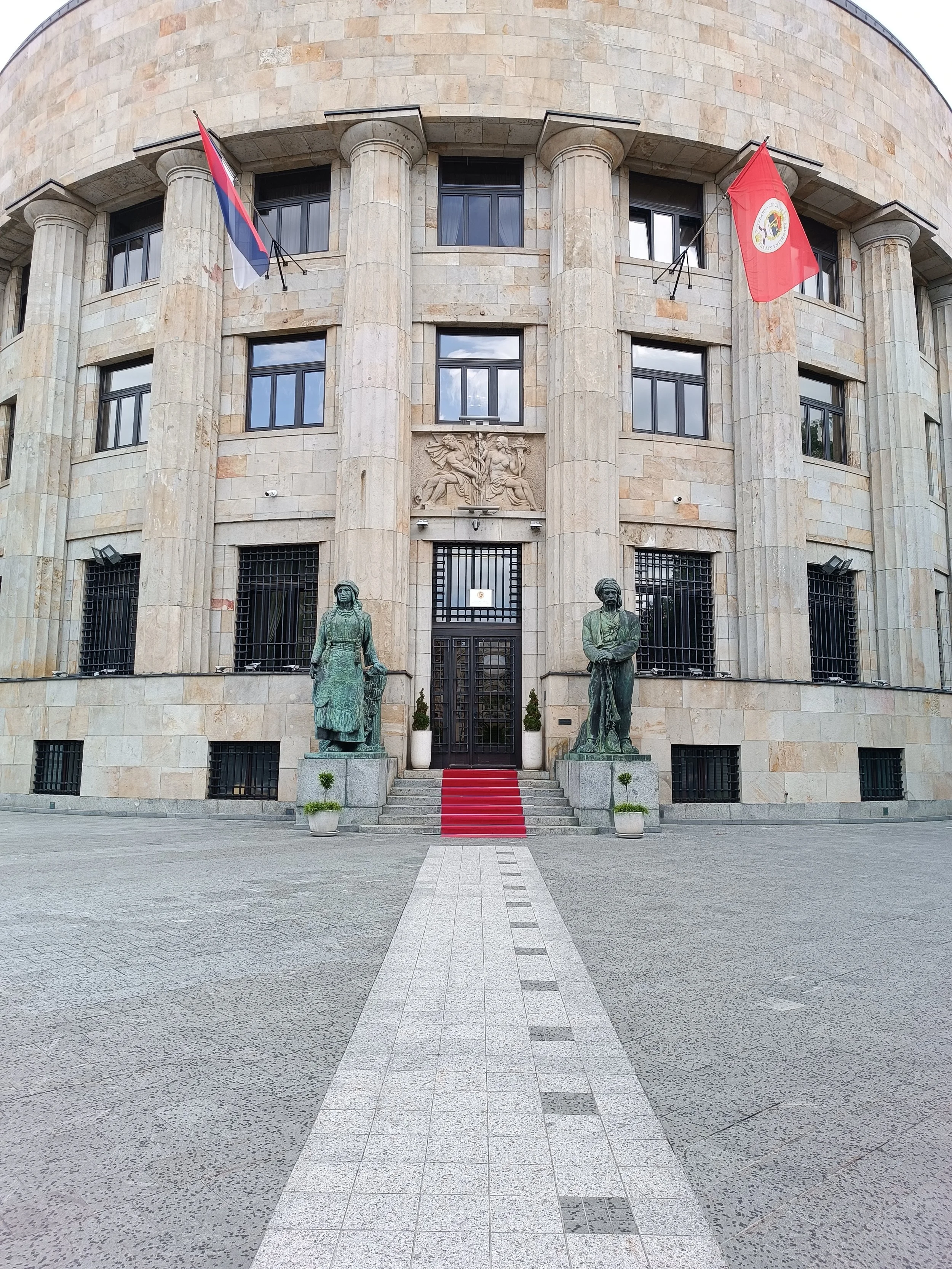
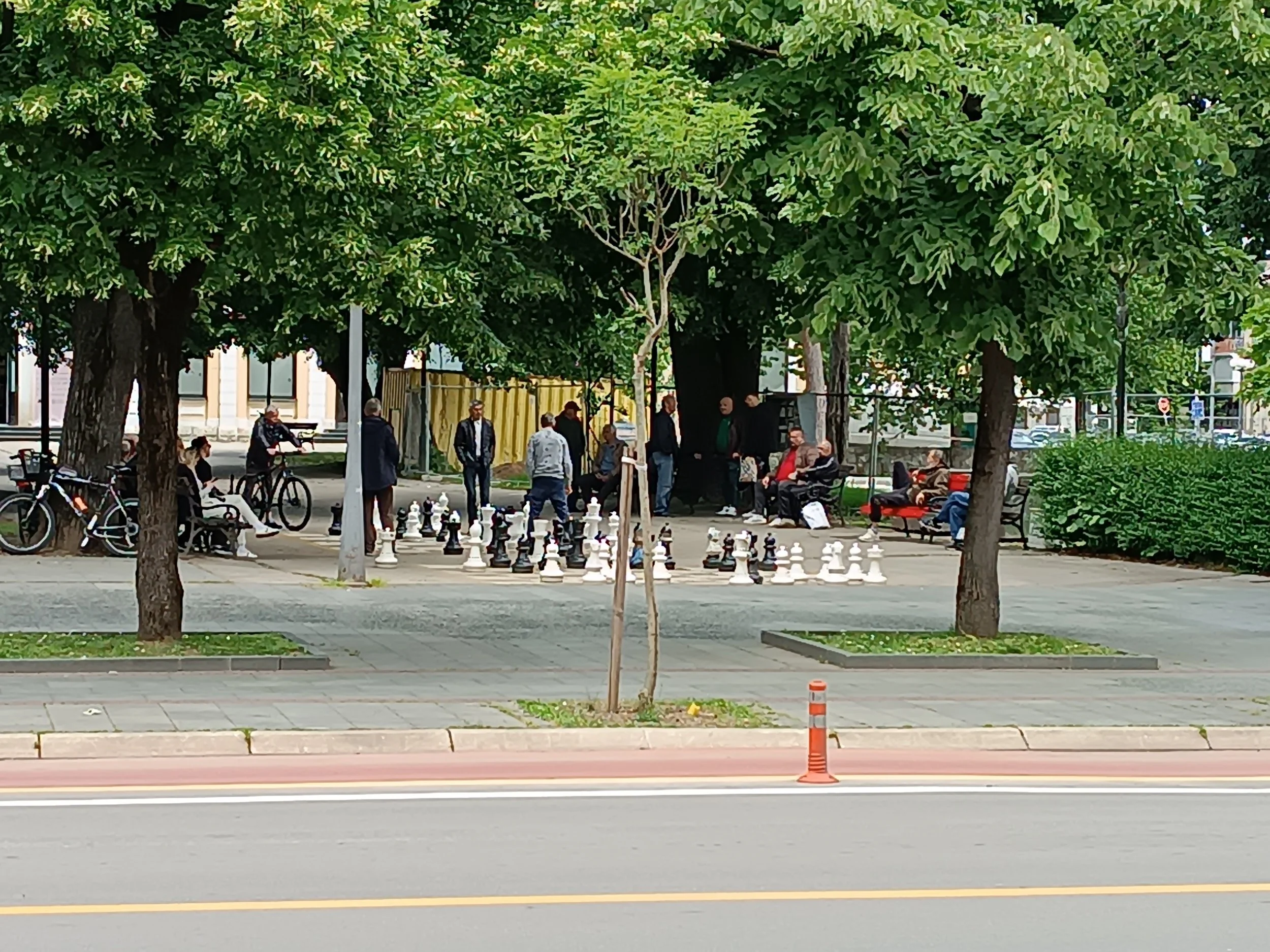
I see flags in Serbian colours, Cyrillic letters, wide streets. A carefully designed public park with music from small speakers and fountains reminds me of a feeling I had in Yerevan, Armenia. I wander aimlessly through the streets, see the Theatre, see the Serbian Orthodox Church; later, the Boska department store and the castle. I can't settle in. The only thing I find touching are the men playing chess in the street and those watching attentively. The only thing I find interesting is the art gallery, whose exhibits
I cannot place in any logical context. Banja and I don't have much time to get to know each other. We don't make much of an effort either; we have nothing to say to each other. Instead, my thoughts are still in Sarajevo, in Srebrenica, lost in the past. And the present? Milorad Dodik, the president of Republika Srpska, speaks openly about a possible secession of the Bosnian Serb territories, loudly denies the genocide of the Bosniaks to this day, and does not shy away from using enemy stereotypes that would be so helpful to overcome.[13] After fifteen thousand steps, I admit defeat and return to my hotel room. The sky has turned grey and the wind is blowing stormily;
a thunderstorm has been forecasted.
Interesting!
During the time of Yugoslavia, Bosnia had one official language: Serbo-Croatian. With the collapse of the multi-ethnic state and the emphasis on individual identity, language was also instrumentalised as the “soul of the people”. Today, there are three official languages with equal status: Bosnian, Serbian and Croatian. It is debatable whether these are separate languages or merely variants of a common pluricentric language, the Serbo-Croatian. But these considerations are of a linguistic nature. In contrast, the “linguistic tripling in Bosnia” has above all a real political dimension. Official documents must be written and published in all three languages. This is madness for the administration in terms of effort and cost.
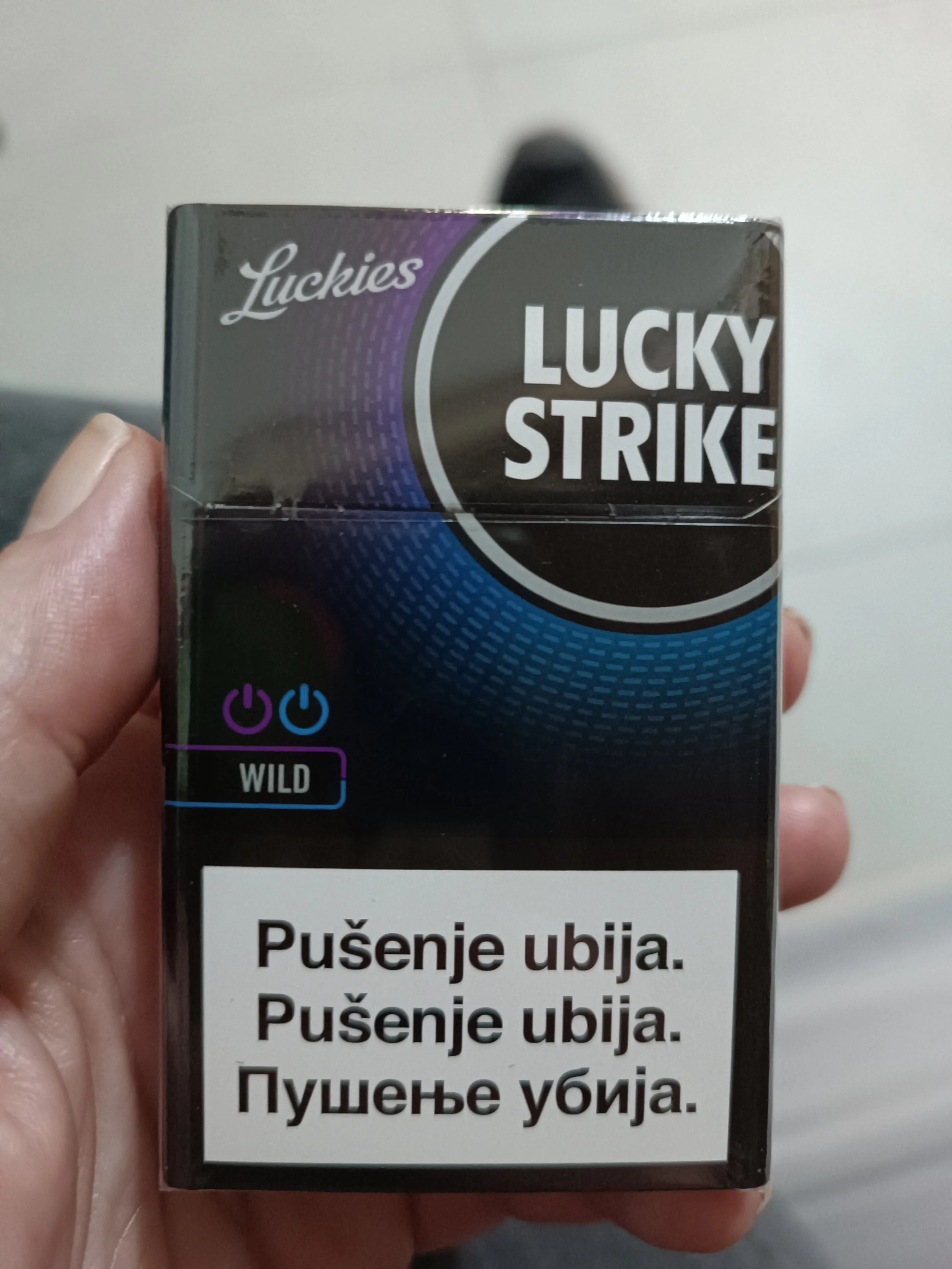
An absurdity, as this example shows: “The tripling also means that forms or product labels often contain the same text three times, as the relevant terms are identical in the three languages, such as the words “smoking kills” on cigarette packets: “Pušenje ubija” (Bosnian), “Pušenje ubija” (Croatian), “Pušenje ubija” (Serbian), this time at least in Cyrillic letters.”[14]
Recommendation:
Documentary
Woodhead, Leslie: Srebrenica: A Cry From The Grave. United Kingdom 1999, 104 minutes, www.youtube.com/watch?v=i_if3Ahi09Y
_____
[1] The official name of the country is Bosnia and Herzegovina. For reasons of simplicity, I will use the shortened form in the following.
[2] See Mlinarević-Sopta, Martina: Stari Most, die Alte Brücke – Bogen des Lebens und des Todes. OST-WEST. Europäische Perspektiven (OWEP), 2/12, www.owep.de/artikel/947-stari-most-alte-bruecke-bogen-des-lebens-und-des-todes (in German).
[3] The three largest ethnic groups in Bosnia are Bosnian Muslims (Bosniaks), Bosnian Serbs and Bosnian Croats. In the preamble to the constitution, they are defined as the constituent peoples of Bosnia “(along with others)” and are officially equal. However, not all Bosnians identify with one of these three ethnic groups.
[4] This clock is exceptional because it is the only active clock in a public space worldwide that continues to display alaturka time, where the day begins at sunset and the hands therefore point to twelve at this time. Since the time of sunset changes daily, as it is well known, the clock must be readjusted regularly.
[5] During the Bosnian War, Susan Sontag spends several weeks in Sarajevo, returning to the besieged city a total of nine times. She sees herself as an ambassador, her most urgent wish: to draw the world's attention to the realities of life in war and to move it to act. This “publicity stunt” and the theatrical production of Samuel Beckett's “Waiting for Godot” in the summer of 1993 were not without controversy. Nevertheless, on the evening of the premiere, she was awarded honorary citizenship of the city.
See Knezevic, Gordana: Susan Sontag's Lasting Gift To Sarajevans Under Siege. RadioFreeEurope/Radio Liberty, 05.04.2017, www.rferl.org/a/susan-sontag-siege-sarajevo-waiting-for-godot/28412155.html.
See Schreiber, Daniel: Susan Sontag. Geist und Glamour. Aufbau Verlag, Berlin 2009, p. 240–246 (in German).
[6] For a refresher, I recommend this five-minute summary of the events at the beginning of the First World War: www.studyflix.de/geschichte/attentat-von-sarajevo-6833/video (in German).
[7] In November 2025, the journalist Ezio Gavazzeni made serious allegations after years of investigation: Western tourists are said to have paid large sums of money during the siege of Sarajevo to be allowed to shoot at civilians from Bosnian Serb military positions. Rumours of so-called sniper tourism have been circulating for years, not least in connection with the 2022 documentary film “Sarajevo Safari” by Slovenian director Miran Zupanič. Even then, the mayor of Sarajevo, Benjamina Karić, filed a criminal complaint as an immediate response. The status of the investigation: unknown.
[8] “During the siege of Sarajevo, officially more than 3,000 pieces of art were created, around 50 concerts were held and more than 170 exhibitions were organised. More than 180 premieres took place in theatres. […] The first Sarajevo Film Festival was held in the city's cellars while the siege was still ongoing.”
O.V.: Belagerung von Sarajevo: Kunst half beim Überleben im Krieg. Frankfurter Rundschau, 01.10.2025, www.fr.de/zukunft/storys/kultur/belagerung-von-sarajevo-kunst-half-beim-ueberleben-im-krieg-93964892.html (in German).
[9] In December 1995, a peace agreement was signed at the military base in Dayton, Ohio, USA, which still serves as the constitution of the sovereign state of Bosnia and Herzegovina today. The state continues to exist within the internationally recognised borders of 1992 and is divided into two entities, the Federation of Bosnia and Herzegovina and the Republika Srpska, each with its own government, as well as a special zone, the Brčko District. The head of state is a three-member presidency consisting of one Bosniak, one Serb and one Croat. There is also a High Representative, a kind of guardian of peace, who is appointed by the United Nations and has far-reaching powers, e.g. to enact or repeal laws and dismiss elected officials. This political system is considered one of the most complicated in the world. Everything exists three times, twice over, multiplied by X. Parity was intended to create equality, but the result has been an enormously inefficient administration and a political system that blocks itself. Thirty years after the peace agreement, the ceasefire still holds, but this peace is fragile.
[10] On 11 July 1995, Bosnian Serb troops under General Ratko Mladić captured the town of Srebrenica in the east of the country. At that time, tens of thousands of Bosniaks were living as refugees in the town, which had been declared a demilitarised UN protection zone. Living conditions had been catastrophic for many months, with a lack of water, food and electricity, so the army encountered little resistance from the unarmed and exhausted inhabitants. In addition, the air support requested by the Dutch UN peacekeepers from NATO fails to come. The people flee, searching for protection in fear of death. Twenty-five thousand Bosniaks, mainly women, children and the elderly, walk to Potočari, five kilometres away, hoping to find refuge with the peacekeepers stationed there. For most of them, this proves unsuccessful. They are separated from their husbands and transported by bus to other parts of the country. At the same time, ten thousand men flee to the mountains, hoping to reach Bosniak-controlled territory unnoticed under the cover of the trees. For many, this proves unsuccessful. They are tracked down in the forests and either murdered on the spot or taken to nearby factories and schools and executed en masse. These atrocities are considered the worst war crimes in Europe since the Second World War. And the world watches.
For a chronology of events, I highly recommend the documentary “Srebrenica: A Cry From The Grave” by Leslie Woodhead.
[11] Tarik Samarah, born in Zagreb in 1965, lives in Sarajevo during the siege and go to Srebrenica after the war to give testimony. He speaks with survivors and photographs the mass graves and exhumations. His black-and-white images express “the boundary between life and death – the reduction of colors brings us into the world of grey, where all norms of humanity cease to exist.” In 2012, he opens Galerija 11/07/1995, which displays both his own works and special exhibitions.
www.galerija110795.ba/exhibitions/permanent-exhibition-srebrenica.
[12] See www.srebrenicamemorial.org/en/page/mass-graves/27.
[13] In August 2025, Milorad Dodik is removed from office after a court sentences him to imprisonment and bans him from political activities for passing illegal laws. Siniša Karan, who is close to Dodik, takes over the office in November 2025.
[14] Stieger, Cyrill: Die Macht des Ethnischen. Sichtbare und unsichtbare Trennlinien auf dem Balkan. Sonderausgabe der Bundeszentrale für politische Bildung, Bonn 2022, p. 159 (in German).
*All websites were last accessed on 5 February 2026 and their content checked.
*Translated with www.DeepL.com/Translator (free version) and ChatGBT. Made some modifications.
